
The Mind Company - Train Your Brain Like You Train Your Body
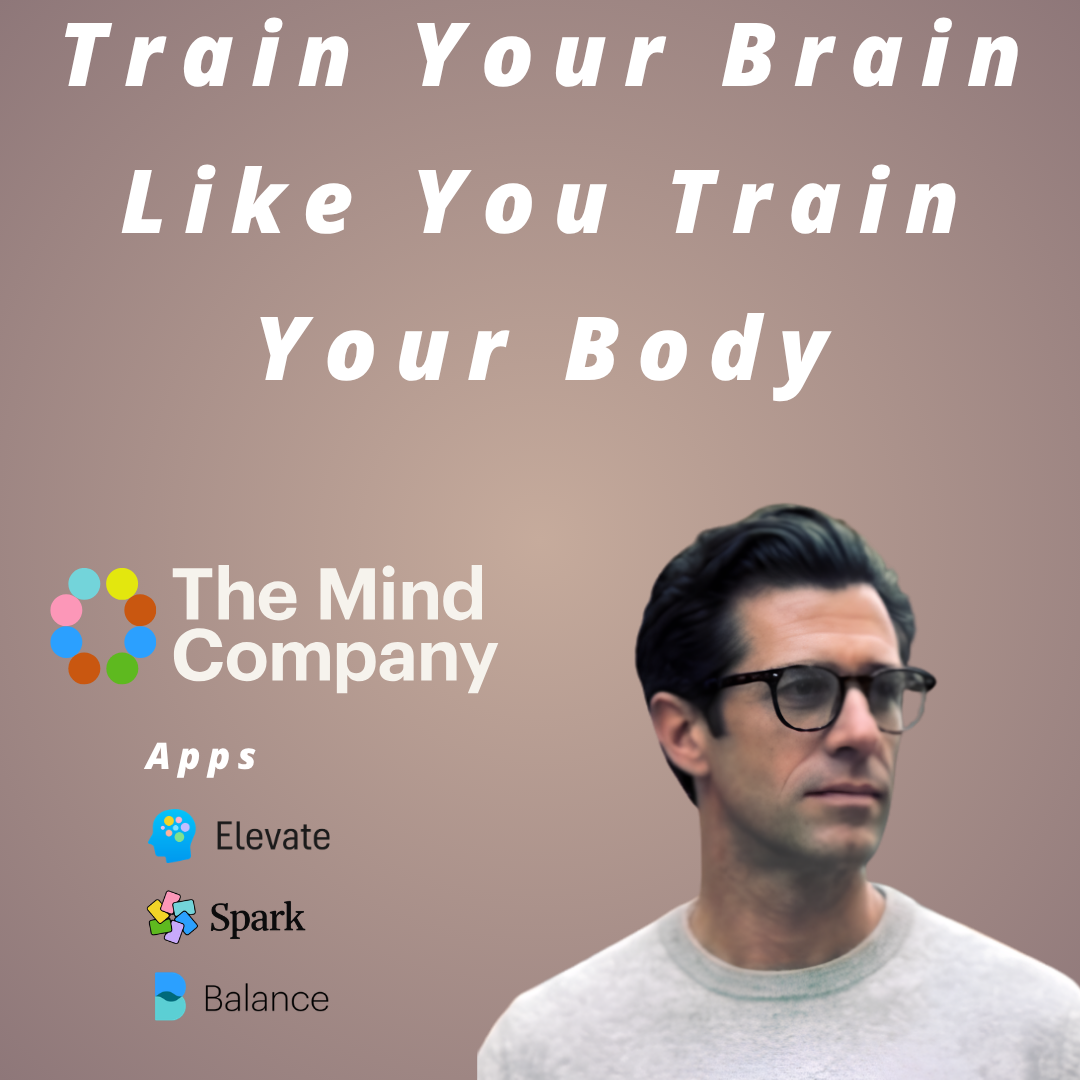
Ramon Vela sits down with Dan Kessler, COO of The Mind Company, for a conversation that starts with a sobering question: what's actually happening to the human brain right now and what can we do about it? The Mind Company is the only company in the world to win App of the Year twice, from both Apple and Google, and with three distinct apps — Elevate, Balance, and Spark — it's quietly building one of the most compelling mental fitness platforms in the world...

 Apple Podcasts
 Spotify
 Castro
 RSS Feed
 Ramon Vela sits down with Dan Kessler, COO of The Mind Company, for a conversation that starts with a sobering question: what's actually happening to the human brain right now and what can we do about it?
The Mind Company is the only company in the world to win App of the Year twice, from both Apple and Google, and with three distinct apps — Elevate, Balance, and Spark — it's quietly building one of the most compelling mental fitness platforms in the world.
* The data behind the mental fitness crisis. Average attention spans have dropped from two and a half minutes to just 47 seconds in the last two decades. IQs are declining. Critical thinking is being outsourced to AI. Dan breaks down the numbers and why the stakes have never been higher.
* Three apps, one mission. Elevate sharpens cognitive skills through brain training games. Balance delivers highly personalized meditation, mindfulness, and sleep support. And Spark, the newest app, is a daily puzzle experience for curious people who want to learn something new every single day.
* Human creativity in a world of AI shortcuts. In an app store flooded with AI-generated products, The Mind Company builds everything with human editors, writers, and designers. Dan makes the case that judgment, taste, and creativity can't be automated and The Mind Company is proof.
* The right framework beats founder mode. Dan shares his management philosophy: give people responsibility before they've earned it, build clear decision-making frameworks, and trust your team to grow. It's how he's built every company he's been a part of.
* Mental fitness is the superpower nobody is talking about. Whether you're a founder, a parent, or just trying to stay sharp in a distracted world, Dan's message is clear: take care of your brain the way you take care of your body — and start now.
Join us in listening to this episode for a fascinating and genuinely thought-provoking conversation about the state of the human mind, what mental fitness actually means, and why the apps The Mind Company has built might be the most important ones on your phone.
To explore all three apps — Elevate, Balance, and Spark — available now on iOS and Android, visit The Mind Company: https://themindcompany.com/
If you enjoyed this episode, please leave The Story of a Brand Show a rating and review.
Plus, don’t forget to follow us on Apple and Spotify.
Your support helps us bring you more content like this!
*
Today’s Sponsors:
Saral - The Influencer OS: https://www.getsaral.com/demo
SARAL is the all-in-one influencer platform that finds brand-aligned creators, automates outreach, and manages everything in one place. Request a live demo today. Let the SARAL team know you're a The Story of a Brand Show podcast listener to get an extended free trial! Visit the link above.
Ramon Vela (00:19.488)
Welcome back everyone. Today is going to be a great show. We've got an amazing program for you today. I have with me Dan Kessler, who is a COO of The Mind Company. Welcome to the show.
Well, I really love brands like yours. I can't wait to unpack it. And we'll talk a little bit about why I love companies like yours. But before we do, I feel strongly about this next question that I'm going to ask you. It's sort of like the opening question that I ask everyone who's on the interview. And I ask this gratitude question for two reasons. One is just a big believer in gratitude. I believe in it's
power to help you release stress and anxiety. I've used it in my most darkest times. I do a meditation around it. But whether you do journaling or meditation or praying or however you do it, having a gratitude mindset, I think it's just an amazing tool and it's free. It is available to everyone. So I like to promote it from that perspective. I also like to ask it because I...
I like to humanize the companies that we have on the show because it's so easy for consumers to see an app or a product online or on the shelf or wherever, and just sort of think it's some faithless corporation. And I like to humanize them and let the listener know that there are real people behind these brands that we feature on the show, that they bleed, sweat, and tear over the product. They care about the community. They care about the product. They care about the consumer.
And one way of doing that is sort of getting to know who you are. And one great way to do that is to find out what you're grateful for. So with all of that said, Dan, I hope you don't mind if you would share a moment or a memory when someone did something for you that just made you feel grateful because it meant that they believed in you, your vision or your potential.
Dan Kessler (02:21.933)
Yeah, I really appreciate the question. And I agree. think, you know, gratitude is something that we can all practice a little bit more. And there's just an incredible amount of science that shows how if you live a life with gratitude, you end up being happier and you achieve more. you kind of like spread that to the people around you. So it's a great question. I was thinking a bit about it. I think the best, the best, the best thing to talk about was very early in my career,
and I was working, this was over 20 years ago, I was working in a entertainment law firm of all places. And one of my first bosses there gave me a lot more responsibility than I think I had the right to have at that time and at that age, frankly. As someone in early 20s, I was in meetings I shouldn't have been in, I was talking to clients that I wasn't qualified to talk to, I was running projects that I had no business running at all and hadn't earned. At the time, it didn't
Ramon Vela (03:07.352)
Hmm.
Dan Kessler (03:22.007)
really make sense. kind of, you I felt a little bit of the, you know, imposter syndrome. But I rose to it, right? And I worked really hard and I tried to make sure I was doing my best. And looking back, you know, it's really, really formative for me to have those opportunities and those chances. But I think what is, know, why having gratitude for that is so important is that today it's a cornerstone of my management style, which is
Ramon Vela (03:30.499)
Mm-hmm.
Dan Kessler (03:51.679)
You need to be able to give people, even at very young ages, as long of a leash as possible to let them sink or swim, to try things, to earn their responsibility through doing and through action. So it was really important for me. It gave me the chances personally, but now I see it really as a way to pay things forward, I guess, as a way to help the younger generation get the same level of responsibility
Ramon Vela (04:24.366)
I love that. And you actually sort of answered my follow up question, which is I normally ask about, you know, closing the loop. You know, one is, have you ever mentioned that to the person who gave you that responsibility, who believed in you in that point, whoever that person was? And then also, you know, have you taken, you know, that example or what you were given and
and shared it with others. And so you just mentioned how you share it with others, how it's become the cornerstone of your management style. And because I think it's important because I think it's, you know, it's it's, you know, one, looking back and being grateful and remembering those who who helped you along the way, but then also taking those lessons learned and then applying them to who you are and what you do and why you do it. And I think those are.
I think those are really important and you're already doing one of those.
Dan Kessler (05:24.199)
Yeah, it's funny. I should probably remind those that have given me those responsibilities. There's also wasn't one, right? was, through my early career, there's a lot of those chances. And some I did great at, some I didn't do so great at, right? Like we all have our successes and failures. But I do think it's important to probably pay that back a bit and let them know how influential they've been for me. that's a good tip and I think I'll do that. Yeah, but paying it forward and essentially,
Ramon Vela (05:33.592)
Mm-hmm.
Dan Kessler (05:54.015)
becoming the chance that you had been given is super important. And I think today it's tough, right? So there's, think, a lot of pressure, especially in the tech industry, to...
step in and get very involved at every single level. And there's been this like trend of founder mode, I guess, where people are.
you know, spelunking down into every single detail and getting super involved. And I think there are times where that's actually very important, especially for founders, you know, who are building their own businesses. I think before founder mode, it was called six Sigma or something. but you know, I think the downside of that, essentially, you know, the, the, the, the newer, nicer branding for micromanagement founder mode, the, the, downside of that is you're actually not training folks as well as you should.
Ramon Vela (06:37.442)
Mm-hmm. Yeah.
Ramon Vela (06:49.307)
Mm-hmm.
Dan Kessler (06:55.055)
And I think one of my concerns in today, especially today is, are we doing enough to teach the younger generation what to do, how to do it, how to have responsibility, how to be proactive? And I don't think we are. And I think that it's critically important that everyone steps in here because when you are in remote environments, like people can't really learn from osmosis as much anymore. So means you got to work a lot harder. So I think the remote environment is actually creating a larger gap in this like,
Ramon Vela (07:18.765)
Mm-hmm.
Dan Kessler (07:25.175)
career trajectory that young folks should have. And then furthermore, think AI is also really hurting them a bit because the things that they would be learning on their own, which is like critical thinking, for example, is actually being outsourced to these machines. And so I think the work of the manager today is a lot harder, frankly. And the work of the manager is now has to be not just like getting the job done because
Honestly, technology can do a lot of that job. But to teach the younger generation how to have the responsibility, how to have the taste, how to have the judgment, how to use the tools, sure, but how to manage their weeks and their days, that they're as efficient as possible. And it's very easy to take your hands off the wheel a bit. And I'm just worried that it'll lead to way too much suffering among the young 20-somethings who are looking for the right kind of job and build their careers.
they're not going to have the same level of mentorship that we used to have.
Ramon Vela (08:28.599)
Yeah. And you really brought up a lot of different points there that I think are really worth exploring. And I think many of which I think will lead us back into the mind company. I, I a hundred percent agree with you. As a matter of fact, I think I shared this with you in our pre-interview, but I, I mean, I, I have, I think about the same things that you're thinking about, not just for, for young people, but just
founders and so forth. just kind of feel like there's a moment in time right now where we need to focus on leadership. And it's not just leadership for founders, but it's also just leadership for yourself, on a personal level. You need to be the leader of your life. You need to be the leader around you. You need to step up and be that. However, in order to do that,
I think you need to learn, you need to learn how to manage your mind.
You know, I sincerely believe that one of the biggest issues that we've, or some of the biggest issues we have currently in our culture around like misinformation, around critical, lack of critical thinking, around social media algorithms, all of this stuff. I think a big part of it, our political divide, a big part of it is our inability to
regulate ourselves and really be aware of our thoughts, be aware of, manage our thoughts, be critical and sort of observe, not only observe but understand our thoughts. I think some of those are really, are really the, I guess for me, I think it's the core of what, why we have so many, some of these issues in society.
Dan Kessler (10:29.293)
So I love to back up. Your instincts are right. fortunately, they're backed by quite a lot of data. So I can share some of these stats because they're pretty chilling. So there's this thing called the Flynn effect, which is that for about 100 years, as they were measuring IQs across every territory, let's focus on the United States, IQs, average IQ rose by about three
points a decade. So, you know, for about 100 years, people were getting smarter three points a decade. And that kind of makes sense, right? Like we were communicating more, we had better access to education, we were investing more in education, people were learning how to critically think. And so that was the trend line, very exciting for the future of humanity. And then I this century, I, you know, maybe 1020 years ago or so that effect didn't just
Ramon Vela (11:24.366)
Mm-hmm.
Dan Kessler (11:29.007)
It didn't stop or plateaued, it reversed.
So now we are losing IQ points every five to 10 years. So people are measurably getting, hate to give you the click bait name for it. People are getting dumber, we're getting dumber. We're measurably getting dumber here. And another good stat here is that the average attention span today, this year, is about 47 seconds. People can concentrate on something for only 47 seconds before
Ramon Vela (11:46.03)
Hehehe.
Yeah.
Ramon Vela (12:03.02)
Yeah.
Dan Kessler (12:03.471)
or they lose interest. Just 20 years ago, right? this, you know, think about it, like I just talked about the beginning of my career, right? That was about 20 years ago. That was two and a half minutes. People could focus for two and a half minutes before they lost attention. you know, we're about 20, doing about 20 % worse than we were, you know, 20 years ago. So, you know, it's shocking. Like we, our brains are not working the way they should. And it shows up
Ramon Vela (12:18.958)
Yeah.
Dan Kessler (12:33.391)
People are essentially outsourcing their critical thinking now to AI. And if you look at happiness and depression levels and all these other elements, really it all started getting, becoming a bit of an epidemic in the early 2010s. And this was with the advent of the smartphone and with social media and these algorithmic feeds that are essentially prioritizing things like outrage or shock and awe over truth.
Ramon Vela (12:53.174)
Mm-hmm.
Dan Kessler (13:03.373)
Um, and so you're right, right? We go, our brains are not working the way that they should be working. Um, now you can maybe try to squint into the data and find a silver lining here and there. But I think ultimately, if you just look at it, longitudinally, we should be getting smarter, not dumber. We should be able to hold our focus. We should be able to, you know, be, you know, manage our emotions. So, you know, I think the superpower for anybody in the workforce or just, you know,
parent or who wants to just be a good member of society has to be to really take care of your brain. That means a couple of different things. So at the mind company, we call it mental fitness. how, you know, what physical fitness is. So what's mental fitness? How do you measure that? How do you define it? We think about it in terms of a mind that is sharp. So, you know, can you find your words quickly? Are you not experiencing any brain fog? You know, are you
Ramon Vela (13:39.875)
Hmm.
Dan Kessler (14:07.441)
The second pillar of mental fitness for us is this idea of, you know, emotional regulation or calmness. So, like, you know, are you flying off the handle or can you manage difficult situations well? And again, people cannot manage their emotions as well as they used to and we all know why. And then the fourth pillar, sorry, the third pillar that we look at for mental fitness is what we refer to as like being knowledgeable. Like you understand how the world works. You understand interesting facts.
Ramon Vela (14:14.54)
Mm-hmm.
Dan Kessler (14:37.895)
Part of that can be, are you fun to talk to at dinner parties? But also you should, when reading something and thinking critically, you should have a base of knowledge on which to apply that new information, which people don't anymore, or not as much as they used to. So we view it through those three lenses. And that's how we've built our company and our app. So our app Elevate, which won Apple's app of the year and has been the leading, I hate the phrase brain training, but essentially a brain training app that helps you stay sharp. We have really fun, engaging games that rival really any app out there, except that it makes sense.
you much more sharp. You're better at mental math, better vocabulary, better reading comprehension and memorization. These are core pillars for sharpness and that's what Elevate helps you with. Our meditation sleep mindfulness app, Balance, which also won app of the year, only company in the world to win app of the year twice. One from Apple, one from Google for two separate apps. So Balance helps is a great and highly personalized way to stay calm and stay emotionally regulated. So you learn these really important skills of mindfulness.
And it's, it's framed a lot differently than other meditation apps. Most meditation apps are these glorified MP3 players, right? Like you just listen to some audio and you feel a little bit better after and they're great. And there's no, I'm not disparaging them at all. I think they're fantastic, but what Bounce does differently, that's really, I think compelling is we compile and build the meditations in real time based off of your inputs. So you're feeling happy or you're feeling sad. You have an
Ramon Vela (15:46.371)
Mm-hmm.
Dan Kessler (16:07.151)
day or a productive day or having a despondent day, the actual meditations are going to be different and will use different meditation techniques for you. And that's, think, really interesting, right? Because now you're actually learning the techniques, know, putting them into your long-term memory. You know which techniques will work for what kind of emotion you're feeling. You can apply that in real time.
Ramon Vela (16:17.646)
Mm-hmm.
Dan Kessler (16:31.669)
And by the way, we have incredible scientific studies that back up kind of both of these that LOA actually makes you sharper balance actually makes you more emotionally regulated. third and newest app, which launched, you know, not six months ago is called Spark. And Spark is based on micro learning. It's incredibly fun puzzles that teach you something really new, really interesting and new every single day. So every day there's a new set of puzzles that all share the same theme. You know, the theme could be spices.
Ramon Vela (16:45.466)
Mm-hmm.
Dan Kessler (17:01.583)
you know, chili peppers, et cetera. theme could be dinosaurs, the theme could be gold, the theme could be the Olympics, it could be really anything. And these games all share these really fun and interesting facts about that subject. And we built it in a way where you actually store this information in your long-term memory. So it's not like you're just watching a video about something interesting and you forget about it five minutes later. We've constructed this app to actually drive long-term retention of knowledge. And so, you know, for us, we feel like we're on a really important mission.
Ramon Vela (17:32.186)
Mm-hmm.
Dan Kessler (17:32.324)
And our company's mission is to bring mental fitness to every mind every day. We want to make sure that we have very engaging but proven tools to help people's brains because like you, we're all looking around at the world right now and we know something is wrong and there has to be a way to fix it and we feel like we are one very important part of that equation.
Ramon Vela (17:54.8)
Well, I love that breakdown you just gave and I have a lot of questions around that. I do want to get into just a little bit about your background and then also the background of and how you got into the mind company just for a second. Before I do that, I just want to make one last comment. I don't want to overdo this, but I really do feel that because of social media and the algorithms and AI and all this other stuff,
I think we as people need to actively do apps, you know, do apps like yours. I mean, we have to actively do it. Like it's not, you know, the thing is, that we are so overwhelmed and bombarded with, you know, these algorithms that, you know, we, we get on autopilot and we don't even realize sometimes what's happening. And I want to be positive about this in a sense that
I know we, you know, what you're saying about we're getting dumber, but you know, we're not dumb people. We're just kind of asleep in the wheel. We're auto, we're on autopilot and we're not using their functions and so forth. know you didn't mean that, but I'm just saying, you know, like.
Dan Kessler (19:05.197)
I'm totally with you on this and like it's We are I think a lot of people are an autopilot, right? Like it's easy to just zone out and start scrolling Instagram or tick tock or something like the easiest thing in the world It is the same thing as eating junk food or sitting on the couch, right? If you're sitting down at a desk all day and you're eating junk food all day Is your body gonna be healthy or not? It's gonna be an unhealthy body, right? And we know like like sitting kills sitting down too much is bad for your body not
exercising is bad for your body. We have that education now and people are doing stuff about it, right? Gyms did not exist 100 years ago. People didn't go jogging for exercise 100 years ago because their day to day lives were very active, right? You had to walk to the next town, right? Ride your horse or whatever. Today you're in cars and on buses and on airplanes and sitting in front of your desk and on your couch and in your bed. And so we need to actively improve our physical fitness. Similarly, our nutrition.
Why? Well, sugars and carbohydrates are very cheap, very easy to package and preserve, and therefore we can feed a lot of people with really bad food. And that was the case for decades. And now people are becoming much more aware of what they're putting in their bodies and what it's doing to their bodies. So much so that, you know, we have, you know, now elected officials that are talking about this and we are looking at food deserts and fixing them, and that's really critical. So,
We've had these revolutions for physical fitness and nutritional health, metabolic health, and we do believe that mental fitness is the next one and people are becoming very wise to it.
Ramon Vela (20:42.448)
Yeah, I agree with you and I'm gonna take, I'm gonna go one step further. know, a lot of people are worried about AI and their jobs and all of this. Well, I personally believe that if you wanna stay ahead of all of this stuff, then you need to be, you need to actualize your potential. You need to...
Actualize your brain. You need to be you know, like I've told this to my my kids a long time for now because when they were You know, they were getting to college age And some of them are still are but I mean when they're going to college age I would say, you know, I have a feeling that you know the technical places and I didn't I'm not like I'm not a futurist or anything like that. But I I told him I believe that the future will favor those
who can use their brain both creatively and critically and logically. if you, basically like a really good liberal arts degree, people made fun of liberal arts degrees for a long time because like, you be, yeah. But I was just thinking like, you need to think critically, you need to use your mind. And I believe that those who do well in the future are those who are able to,
Dan Kessler (21:55.021)
I know, it's back in style now, who knew?
Ramon Vela (22:07.994)
who be able to do those things. And through apps like yours or whatnot, people can still do them even if they're not in school. And if you're worried about AI and you're worried about all this stuff, I just think sharpen your mind, learn to think critically, learn to think without necessarily getting overly emotional, but realize kind of like seeing the world the way it really is, to steal a Buddhist term. But I think people...
I think that's going to help people. think as we move forward and we evolve in our culture and so forth, those are the people that are going to, who are going to thrive in this new sort of era. Because I mean, AI is coming. There's nothing we can do about it, right? It's going to come. And I think in order to thrive, I think we need to fully actualize our mental capabilities and of course our health and everything else, but our mental capabilities, I think are going to help us thrive. So I think that falls right into
into your guys wheelhouse, which is the reason why I'm so excited about having you guys on the program. So yeah, so let's talk about, let's find out a little bit about you. So you can just take us back maybe like right before, what I would like to find out is right before you were joined the mine company, what was it about the mine company? What was it, if they pitched you or if you.
researched it and applied or wanted to join the company or whatever, what was it that led you to the company and why did you want to join a company like The Mind Company?
Dan Kessler (23:41.709)
It's a great question. I guess put myself back in my mindset back then, a couple of ago. And I've worked for startups a lot, fact, pretty much only startups. For better or worse, it's become my thing, which is scaling these companies from whatever series A, B, C, D, et cetera.
Dan Kessler (24:11.309)
I was generally market, right? Like I was looking for a market that I was fairly passionate about. And I really always loved, not just like kind of the digital health market broadly, but specifically the idea of mental health and the companies that are really trying to pursue that. It's something that I feel strongly about. I previously in my career, I was an executive at Headspace, kind of like from the series A to series D time period. And so like, I really was enamored with that market. I think it's really interesting. It's one of those things that like, you can change the
Dan Kessler (24:44.333)
So that was a big part of it, honestly, was I just loved the market. The second thing I love the products. There are very few products out there that are as well built and designed and have the right attention to detail as the ones that our CEO, Jesse, makes. So Jesse is this incredible product thinker and designer. He's the best zero to one builder I've ever seen. And he just has an attention to detail and care that you don't see in other apps. And so that was another one that really, to me, felt like a big difference.
rent sheet or and then you know, I think the the other kind of key thing when looking for a job, you know, perhaps my advice to the young folks, it's Yeah, you know, is it is it a market that you that you like and you're passionate about? Because if you don't like that market, you know, if you're kind of like, you know, bored of it, or you think it's uninteresting, you're not gonna last more than six months, right? You're just gonna you're gonna give up, right? There's nothing keeping you going. So you got to care about what you're doing and why you're doing it. Second is the team like, do you actually love and appreciate this
team, do you think this team can achieve? they high quality people? So especially with Jesse, you know, um, and the rest of the team, I just felt like these were great people who were working hard and had good, energy. And then the third, you know, I think framework for this was, um, can I help? Am I, am I uniquely positioned to help this company achieve? Um, is it, know, and that's a combination of whatever, you know, whatever few talents I have. Um, and will my flaws.
not get in the way and you know, my experience be helpful here? And will my hard work help propel them? And if the answer to those three questions, right, the market, the team and whether you can help if those answers are yes, and this is great company to join. And so that was really like, I think, like my overall overarching thinking here. I went when joined the company. And now, you know, several years later, absolutely paid off. This is a it's a great place. The team continues to be fantastic. We're
achieving a lot, we've accomplished a lot in the last couple years. And my partnership with Jesse is great. I love working with him and I learn a lot from him every single day.
Ramon Vela (26:53.679)
Mm-hmm. Well, that's fantastic. mean, I think thank you for breaking that down. I love this aspect of your personality in that you structure your thoughts in such a way that you can share things not only about yourself, but in ways that help other people. I don't know if you noticed that. You have a great way of doing that. So thank you.
Dan Kessler (27:16.629)
Perhaps a blessing and a curse.
Yeah, I think it's, I like to think of myself as a fairly creative person, know, someone who wants to think things through differently and isn't often a trap in that where you can just start stringing things together and it kind of makes no sense to anybody. So I try to work hard at creating these structures and frameworks. I think it makes communication better, helps me also understand things better. And then, you know, it's especially a very good, I think, management technique
because if you can set up the right framework and structures for your team, then there is often very little debate. Oh, should we do A or B? You oh, well, what's the framework? What's the decision making framework? What's the system we put together to make that kind of a decision? So, you know, it's a little bit extra work, right? Because you gotta think a little harder sometimes, but I find that it makes things a lot more efficient. And also just, you know, people, you can communicate a lot better with people.
Ramon Vela (28:15.568)
Yeah.
Ramon Vela (28:19.109)
Yeah, no, I love it. I love it. And that's why I pointed out, it's a compliment because I can really appreciate that because I interview a lot of people over almost eight years of doing this. I've interviewed over thousand folks and it's all over the place. sometimes people's thoughts are all over the place, but I appreciate what you do. Okay, so.
Let's break down the different apps, because you've got all these apps and some of them, and I read that, you like you mentioned earlier, two of your apps have garnered awards through Apple and Google and other places. And so let's talk about that. But I want to make sure that we give a holistic view, which I think you've kind of already given. And then I think what people want to know is a breakdown of each of the apps and what they do. And then
And then if someone's listening to this, like where do they start is something we can keep in mind. And I'll remind you later as we kind of finish this portion of the interview. Because I think it's, I don't wanna overwhelm folks. And I'm assuming that someone can go along and use different apps at some point. Maybe there's one subscription or maybe.
Maybe there's multiple subscriptions. don't know how that works, you'll explain it to us. So someone's listening to this. From that perspective, can you describe the different apps?
Dan Kessler (29:50.669)
Yes, of course. So we have three apps as a company. We're always working on new things and testing things, but we have three apps live right now. The names are Elevate, Balance, and Spark. Those are our three apps. So the most recently launched one is Spark. So Spark we launched back in November. On day one, we are top of the app store. We have been growing organically, which has been a huge achievement for us.
ever since. And the goal of Spark is just to, you know, be the right kind of app for curious people. If you're curious about the world and learning new and interesting things, Spark is the best and most fun way to do that. Every day there are four new puzzles, highly engaging, great experiences. You know, think like kind of close, close in, close to like the New York Times games, perhaps. So these are fairly casual. They don't take that long. But all three puzzles
Dan Kessler (30:55.189)
So you'll have a theme every single day. The theme resets every 24 hours. And the theme is about something interesting. It could be about natural sciences. It could be about the economy or history. And we have an internal team of humans, very little or no robots involved. We human editors and writers that are coming up with this. They're using, as you had said, human creativity.
the research, they fact check everything, they find real images that we license online, we're using real photographs, real paintings, we don't rely on AI generated images. And our content creators, they will create every theme day and create every puzzle from scratch and launch it. You'll even see in the app who made that day. Who's the author, It was a good byline.
And, and so we constructed this, you know, hoping to not just attract people that are curious about the world and how the world works. But also we want to create the best and most fun way to learn something new. And so every single day with these themes, there'll be a whole lot of facts that you'll be trying to understand and organize and these facts will be repeated throughout the games. And as we repeat these facts, what we're doing is we're connecting, you know, neurons in your brain.
So, you know, one of our earlier puzzles, and I use this reference a lot, was about rebellions. And so you hear the word rebellion, and it can mean a lot of different things. So we talked about, you know, the Haitian rebellion, the U.S. revolution, and we even talked about David Bowie and rebel-rebel, you know, musical revolution. And what that does, by using different types of rebellions in one game, we're actually stitching the connections together in your brain. We're kind of forming these
Ramon Vela (32:31.792)
Hmm.
Dan Kessler (32:50.479)
neural connections by both relying on what you already know and introducing disparate concepts that have some shared similarities. And that is, you know, kind of the science of how you learn new things. So that's Spark, an incredibly fun way for curious people to learn something new every single day. It is free to play every day. There is a subscription which has additional features, additional games, access to previous days and archives. And so it is monetized that way. We're not yet monetizing via advertisements.
subscription or free.
Ramon Vela (33:22.961)
In this app, which age group is good for this?
Dan Kessler (33:27.487)
All of our apps are for 13 and over. We don't target children with our products. But mostly I'd say this is probably for people in their 20s, 30s, 40s. That tends to be most of our demographics are like the millennials even up to Gen Xers across all three of our apps. So that's Spark. We also have Balance. Balance is our meditation and mindfulness app. This one's particularly interesting. So we have two.
Ramon Vela (33:39.537)
Hmm.
Ramon Vela (33:46.223)
Mm-hmm.
Dan Kessler (33:57.343)
you know, premium meditation and teachers that are inside the app, There's a male voice and a female voice, a FOSU and Leia. And, you know, they are our meditation instructors. They've been doing it for decades. You know, they're trained among the best. And the way the app is constructed is to teach you the key skills of mindfulness. So there's a lot of techniques that you can use when you practice mindfulness. And the app itself is organized around these techniques.
So every time you listen to a meditation, it's going to be a little bit different than somebody else. So your meditation will be different and distinct from anybody else's because the meditation for you is personalized to you based off of how you're feeling, what you've already learned, what you need to learn, what your trajectory is on this path. And so what we do is we compile these meditations to suit you. And in doing so, you end up learning all these really engaging techniques. even have, you know, fun little quizzes built
into the app where we kind of ask you questions about what you've learned to assess whether or not you've established this and put it into long-term memory. And if you score well on the, you know, little mini quiz, it's more fun than a test, I promise. If you score well on it, you know, we'll give you more advanced techniques. If you don't score that well, we might reinforce things. So it's a real learning experience. It's kind of like having an actual instructor next to you.
Ramon Vela (35:12.443)
Hehehe.
Ramon Vela (35:19.249)
And what kind of thing?
And what kind of techniques are these breathing techniques? Are they concepts around mindfulness? What kind of techniques are we talking about?
Dan Kessler (35:30.279)
They're all the above. So we have some breathing techniques. mindfulness techniques, visualizations. Gratitude is built into it as well. So things like gratitude are built in. So there's a range and library of techniques that you might learn that are all related to meditation and mindfulness.
Ramon Vela (35:48.306)
Well, I love that one of my issues with some of the mindfulness apps is they're like what you said, they're like mp3 files and that's all, you you're just listening, they're not customized. But also, many of them don't go into the concepts behind mindfulness. Like they might teach you like meditation, which is great, but that's surface level, I think.
you really get the most benefit out of mindfulness when you start learning some of the concepts behind it, you know, and start applying that to the meditation and to the awareness of your thoughts, et cetera. So I can appreciate that. And I haven't used your app yet, but the way you're describing it is really making me, enticing me to use it. So I'm sorry, I interrupted you. You were gonna talk about the next app?
Dan Kessler (36:34.571)
Yep, give it a try, please.
Dan Kessler (36:40.631)
No, no, no, it's great to hear. And yes, and I think that was part of why we built it was, this predates my joining the company, but we looked at the market meditation market, this is in the late 2010s. And there was this realization that, they're all just these MP3 players. And are you actually learning these techniques? Are you actually learning how to apply mindfulness to your day to day life? When you have a difficult interaction with your kid, are you checking in and checking your emotions?
and thinking about how to respond and being in the moment or you flying off the handle and letting your emotions take over. And the truth is, unfortunately, a lot of meditation apps are much more of a painkiller. Like you feel good while you're listening to the nice voice. Your eyes are closed, you your headphones in, there's a soothing voice, you know, blasting into your eardrums. That is good in the moment. But if you really want to improve your life, you need to
to learn key techniques and apply them day to day. So that was what we endeavored to do here.
Ramon Vela (37:44.05)
Well, can I? Yeah, can I mention one thing is the great thing about this app is something is my other issue or not issue, I should say, but it's the only the other thing that I mentioned to people around mindfulness is that mindfulness is a practice because once you learn stuff, even if you learn the techniques and if you learn the breathing and so forth, life is difficult and life gets in the way and you're taking your kids.
and you've got three young kids in the back and you're taking a trip and it's easy for you to start going back to your old behaviors and yelling and screaming and everything else. And of course, life is so anxious and you can easily fall back into old behaviors. So it's a practice. It's something that it doesn't just like once you get it, you're done. It's something to have an app like yours and to be able to do it on a daily basis for whatever time you have it and whatnot, a little bit a day.
I think is really, really helpful because it's so easy to step back into your old behaviors. But I will also say that once you start learning certain techniques around mindfulness and mental health, and the first time you use it without even thinking, because it's become a part of who you are and it's become a part of your thinking, that's when it blows your mind. I remember the first time I...
I started rethinking about a situation in the middle of the situation. I was going to respond and I was going to lash out. And then all of a sudden, like this thought came in my head and thought, oh, wait a minute, like, this is different. This situation is different than what I think. Like I was about to respond the way I always responded. And it just hit me, a concept just hit my head and just thought, okay.
I can respond differently. Like it all happened within seconds, like milliseconds. And I realized, wait a minute, this is what all this mindfulness has been helping me with is this moment. But I also realized that these moments are fleeting because you can step back into your old behavior. So to have an app like yours, I think is really crucial. So anyhow, I just wanted to comment on that. Yeah.
Dan Kessler (40:00.237)
Yeah, and by the way, no one's perfect, right? Even Buddhist monks, I think, fly off the handle sometimes.
Ramon Vela (40:07.974)
Yeah, well, I mean, there's an old saying about, you know, there's a reason why, you know, who is it? A couple of sayings. One is a saying where there's a reason Buddhist monks, or try to be an enlightened person when you're in a car with three kids screaming in the back, you know what I mean? Or something like that. Or there's a teacher named Ram Dass, and he says, you know, if you think you're enlightened, try going...
Try and go into your family's house for over the holidays and see how like you are. You know what mean? It's like.
Dan Kessler (40:38.061)
Yeah, right, these Buddhists, they're not going to Thanksgiving with their extended family, right? Like it's a lot easier to reach enlightenment and be completely even keeled when you're hiding in a monastery. think, but daily life is complex and it's stressful and nobody is perfect, but I think we could all benefit from having these tools and skills at our disposal.
Ramon Vela (40:42.322)
Yeah.
Ramon Vela (40:52.7)
Yeah, yeah.
Ramon Vela (41:04.134)
Yeah, I agree. Okay, so the next app.
Dan Kessler (41:07.373)
So finally, the last one I'll talk about is our flagship app Elevate. So this was the first app the company, you know, launched. This is, and I hate the phrase because was essentially, essentially it's been, you know, muddied a bit, but the phrase is brain training. I don't like that it sounds pseudoscience-y. We're not pseudoscience at all. What the app is, it's highly engaging, really fun games built around things like
vocabulary, mental math, memorization, reading comprehension. So, you know, it'll, you you'll be playing a game like any other game where you're, you know, it's like where you're trying to get a rocket ship to keep flying to the finish line, except that, you know, in order to keep the rocket ship flying, you need to be choosing the correct vocabulary as you're going. And so, you know, there is a...
A lot of love for this app, right? You 50 million downloads, right? So it's not a paltry experience. It's one that has been loved by many people for very, very long time. And what's great about Elevate is as you play these games and these puzzles, you are learning new words. You are improving your mental math, even me. So I'm a math guy, always been a math guy, studied physics in college. I'm pretty good at mental math. You know, I applied all the time.
help my daughter with her homework. And even for me, using this app, I've gotten better at mental math because it teaches you really good tricks and skills to be able to do quick math in your head. Same with vocabulary. You learn these words a lot better than through other methods like index cards. And this is just important work. It not only strengthens the brain and exercises the brain, but you're actually developing skills for your day day life. You're a far better communicator if you have better vocabulary.
You know, you're able to operate much more quickly and smartly in society if you're better at memorization and reading comprehension and mental math. So we have created the most fun way to develop and maintain those skills. And I think it's also worth mentioning it's a very engaging app. It's really fun. People use it every day. I'll give you a stat that I think is particularly impressive. you know, we've like a million paying subscribers. If you look at our,
Dan Kessler (43:36.895)
If you look at our usage, what's the number? It's 47 % of our paying subscribers have a run streak. So that means use it every single day. Have a run streak of 100 days or longer. So almost half, 47%. I'd love to round it up, but I'll give the exact number. 47 % of our paying subscribers have used our app for a hundred or more days. Now that is absolutely a testament to this user.
Ramon Vela (43:53.445)
Right.
Dan Kessler (44:06.799)
experience to the design, to how engaging it is. So it's not just people who like want to improve their minds and want to, you know, be better. But they also found the tool that they can use every day and have fun using it. So, you know, we're very proud of that app as well. You know, all three are very successful in their own way and all three, you know, work out a different part of your brain. I think they're all great used together. I use all of them every day. But of course I am supposed to. I'm the CEO of this company. I got to use the product.
Ramon Vela (44:34.787)
Thank you.
Dan Kessler (44:36.719)
But I do believe that if people use these apps every single day, they will feel the difference and they will feel a lot of gratitude for what it's doing to their minds.
Ramon Vela (44:47.314)
man, they sound amazing, all three of them. And even the third one, like I told you, just listening to you is really enticing me to download the apps. I like to do Sudoku with my daughter. And we do puzzles and stuff like that, but this app sounds like it's something she would love too. And as I was listening to you describe all three of these apps,
I started also thinking you mentioned about millennials, you know, that age groups are being your, your target audience right now. But I'd have to say, like, I don't feel old, but I know I'm getting there. But you know, for those who are like me 57 and, and, and above, I really feel like these apps are really, really, important for that age group as well. You know, what I've noticed a lot of my peers is that unfortunately, as you get older, you start to.
cement into your thinking and like, hey, this is what it is and this, like you become very rigid in your thinking. And I feel like, you know, like that's the opposite of what you should do as you get older. Like I think you need to keep your mind sharp. You need to keep thinking out of the box, being creative and so forth, you know, and having an open mind and an open heart.
Dan Kessler (46:07.627)
Well, it's also very much proven that, you know, folks who do the crosswords, talk to friends, are social, meditate, read, do math. If you are active, your brain lasts a lot longer. But the brain is truly a use it or lose it sort of a thing, right? Like, and, you know, if you're not reading, if you're not developing new skills, if you're not pushing yourself to its limit, much like physical health, your brain
Ramon Vela (46:27.953)
Mm-hmm.
Dan Kessler (46:37.691)
will deteriorate and that is quite unfortunate. you're seeing it now. think so we do see our demographics are interesting because especially for elevated is a lot of like Millennials and Gen Xers who use it and you would think it's is it like young kids who want to do all the SATs or is it old people who are worried about dementia or experiencing it you know or had a stroke or something and in reality we have them also but we see a lot of Millennials and Gen Xers and I think what's going on is
Ramon Vela (46:49.637)
Yeah.
Dan Kessler (47:07.991)
They're very aware and very educated. They see their parents getting older and what's happening to their parents. And they're saying, I'm taking care of my physical health. I'm taking care of my nutritional health, but my mental health needs work as well. So I'm going to use these apps so that I will age better than anybody else or that I'm seeing my parents age. I want to make sure I stay as sharp for as long as possible. So yeah, that is, think what's going on. It's not really hard to suss out from the data, but it seems like that truly is our
Ramon Vela (47:12.402)
Hmm.
Dan Kessler (47:37.401)
demographic, which is people who care about themselves, care about their brains and want to put extra effort in.
Ramon Vela (47:42.513)
Yeah, well, and I agree with that. And you my daughter, she's a late 20s, but she's really loves all this kind of stuff, too. She's the one that got me into Sudoku. So this is fantastic. So OK, so the next question is. Someone listening to this loves this conversation about the mind and about keeping up and continuing to train your mind and all this other stuff.
Where do they start? there one app that you would start over the other? Would you say download several of them because you said there's a free version of them and then there's a production version?
Dan Kessler (48:18.059)
Yeah, you can download all of them and try them out. There's free versions, free trials. You can do whatever you want. You know, I mean, our newest app Spark, I think is particularly special. It's just very unique in the market. But you have to, you know, be, think, a curious person who wants to learn about the world, you know, to be into it. Luckily, I think there's a lot of people out there like that. So if you're not curious, probably not your thing. You don't like learning, not your thing. But if you are, it's a great app. So I'd recommend that app for sure, because it feels very
unique, given what else is out there right now. You know, I think if you are curious about meditation and you want to, you know, have a more emotionally regulated life and you want to work on sleep and kindness and be a better father or a better, you know, mother or a better daughter, know, Balance is a really solid app for those types of folks. We actually see that Balance is most popular with young moms. So young moms who don't have a lot of time and have a lot of stress, they seem to turn
to balance. They really enjoy how that that app teaches them the right skills they can use in the moment with their kids. Finally, you know, elevate. Yeah, I think elevate is really our flagship, our oldest app has been around forever. But like, it's the it's best one in this market in terms of, you know, brain training and really working on your mind and keeping it sharp. And so, you know, if you're someone who says, you know, I am worried, like, I'm not using my brain as much as I'd like to. So it could be maybe you're a fast food worker, you're
Ramon Vela (49:22.79)
Yeah.
Dan Kessler (49:47.775)
or work at a gas station, you're a barista, or you're an actor, or a musician, and you want to work out other parts of your brain. Like, I don't do math that much, right? Or, I don't read that much, and I want to have better vocabulary. Elevate is a truly great way to do that. So I'd say Elevate's good for rounding out your sharpness if you find yourself in a particularly narrow career. Elevate's good to just keep the brain a little bit more flexible.
Ramon Vela (50:15.859)
You know, and something you just said right now that I just want to highlight, and this is another reason to try your apps. If you are a millennial, if you've got young kids, you're starting off your journey, take it from me, I've already gone through my journey and I still have the journey, but my kids are already in their 20s. So I will say that one important reason to do
all three of your apps, whether it's the Elevate or the Spark or the, what was the original one, the first one? Yeah, Balance. Is that what you do and how you perceive the world, how you think about the world, how you react and or respond, all of this is absorbed by your kids.
Dan Kessler (50:53.133)
Elevate, and Balance. Those are the three apps.
Ramon Vela (51:14.603)
So if you have little kids, by you changing your life and you improving your life through these apps, your kids will absorb that. you know, I grew up, my parents were, you know, thankfully they bought, I don't know if you remember those sets of encyclopedias that people used to sell, right? And so my parents, you know, and it was a lot of money.
Dan Kessler (51:33.271)
Yeah. I think I had World Book Encyclopedia when I was a kid.
Ramon Vela (51:38.708)
Yeah. And so my parents bought one, it was like the mids 1970s. They bought one and I remember I was just kind of bored. And so I eventually just started reading them and I read through all the entire encyclopedia. Some of it information obviously is outdated and so forth, but it was just a great experience. It was a great experience to learn and so forth. So what I did with my kids is that every day, not every day, every weekend we would go to
like we do some karate or something like that, but then we'd go to the library and each week we would have, you know, a pile of books that they would, that we would take and we would read. And I just really got them into all of this kind of stuff. What I didn't do as growing up is I didn't learn about mindfulness and all that other stuff, not until much later in my life. And I wish I would have, I wish I would have been able to regulate my emotions better. I wish I would have learned how to deal with anxiety and stress a lot better.
And so just for any of you, anyone out there listening who has kids, this is a great opportunity for you to, to learn the skills, not only just for yourself, but if you do have kids know that they were going to absorb what you learn. They're going to absorb how you deal with things and how you learn things and how you respond to stuff. anyhow, that was my little, what do they call it? PSA. So, this has been fantastic, man. I want to be respected every time.
So let's make sure that people know where to go. And oh, by the way, what's your favorite app?
Dan Kessler (53:12.077)
Ooh, that's a really good question. I mean, I love, you know, she's your favorite kid, right? It's hard. You know...
Ramon Vela (53:14.289)
Or is that an unfair question?
Dan Kessler (53:23.253)
I will say, know, elevate has been surprising for me. think I probably had a little bit of our, you know, go back five, 10 years or whatever, arrogance about the idea of brain training. Like, I'm a smart guy. have a demanding job. I use my brain every day. I don't need brain training. And I have been quite surprised by how much I've improved using the app. So I think that's like, I think one good PSA and yeah, I think our newest app spark is really special, honestly. And I'm a very curious guy. I love learning new things. I love
love fun facts. It's kind of like my perfect app. I mean, luckily for the company, I'm not involved in the product development process, so I just benefit from it. But it really is a truly fun way to learn something new every single day. So, again, hard to pick your favorite kid, but each one has its massive benefit.
Ramon Vela (54:00.851)
Hehehe.
Ramon Vela (54:16.539)
Yeah. So, all right. So just let us know where to go in order to find these apps and then any social media handles that you want to provide.
Dan Kessler (54:25.869)
So you can just go to our website, themindcompany.com, like super easy, themindcompany.com and you can find links for all three apps. They're all available on the app store. So if you search for Elevate or Balance or Spark, we should pop up. All published under The Mind Company, if you wanna go to our company page there. And that's both on iOS and Android, so all easy to use. There are no web versions for these apps, they're only mobile apps.
Ramon Vela (54:59.997)
All right, fantastic. Any last thing you want to leave with the audience?
Dan Kessler (55:05.037)
No, you know, I think it's just,
I think for anyone who either is curious about brand and mission, I think our apps are really good example of.
where human judgment and human creativity is still really important in today's day and age. The app stores are completely inundated right now with apps that have been made with AI. And so you're seeing thousands and thousands of new apps every single day that people are just throwing together using Copilot or Cursor or something. And I think
think what you'll find as we enter this new era is that humans are critically important. Like yes, we've got these really new and great fast cars like AI, it's like a souped up great feature rich car. Still have to be a good driver. You still have to know where to go.
And so that level of judgment, I think, is missing with a lot of these new technologies and softwares that being built. And I think our, I believe very strongly, as I see it every single day, our company has the right balance. And if you want to see what real human judgment can do and what real human creativity can do to create a good, engaging human experience, I think our apps are the best examples out there.
Ramon Vela (56:35.388)
Right. Well, I love this and I agree with you on that. And, and I look forward to checking out the apps myself because all three of them sound like they're right up my alley. So I love to, I love obvious. I mentioned, I love to meditate and I love mindfulness, but I also love to.
you know, stretch my mind and think critically and learn new facts and so forth. I love playing those games that like trivia games and things like that. I also love math too. So and I play, I do math games just out of fun. So that's kind of kind of weird, but still cool. think. So I appreciate this. You've been a great guest. more than welcome back. What I didn't do is I didn't mind your expertise around startups and so forth and entrepreneurial stuff.
so you're welcome back anytime we can talk about all that stuff. but the apps were just so exciting and just so interesting in terms of all the different topics that I thought I'd focus on that. But I do appreciate, you and thank you for coming on.
Dan Kessler (57:37.483)
Yeah, I appreciate this. And also, really great conversation. I love your perspective and insights here. So yeah, thanks. Looking forward to chatting again one day.
Ramon Vela (57:47.602)
Yes. So everyone out there, have just had Dan Kessler, who is a COO of the mine company. You can go to the mine company.com. Just keep in mind, there's no web version for these apps. You got to go to your Apple store or Google store and you'll be able to find it. Just type in the name of each of the spark balance and or elevate and you'll be able to find it. Spark is the newest one. You might want to check that one out, but they all sound great. So go check them out. I always mentioned that,
I always say in the end, ending of this interview is that always stay sane, stay healthy. And one way of doing that for today is be having a healthy mind. So go check out these apps. I think they will help you. I've already mentioned, we talked a lot about why this stuff is so critical and so important. So definitely go check them out. And then beyond that everyone, one last thing.
We've all been going through a lot of stuff since the pandemic and obviously the world feels a little crazy right now. There's a lot of anxiety, a lot of stress. I'm assuming this balance app can help with that as well. And so whether you use balance, where you use gratitude, all this other stuff, please, one other thing we can do is just be a little kinder to each other. And I know we can make this human experience a better one. So beyond that.
Thank you from the bottom of my heart for listening to another episode of the story of a brand.
