
Moxies - Building Tech That Protects Childhood
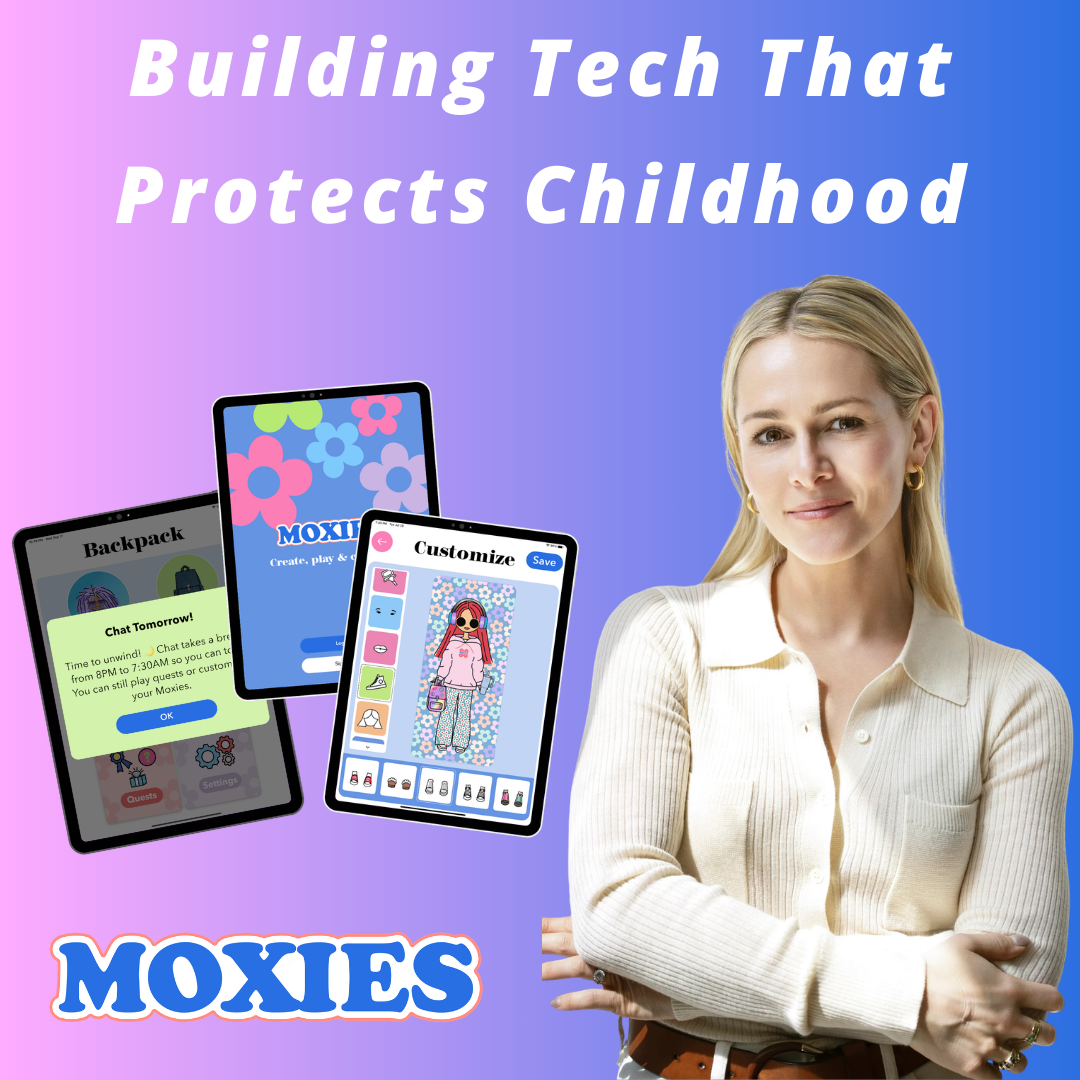
In this episode, I sit down with Juliette Blake, Founder of Moxies, for a powerful and deeply relevant conversation about kids, technology, and what it truly means to build with intention. Juliette walks us through the growing mental and emotional toll today’s attention-driven platforms are having on kids—especially girls...


In this episode, I sit down with Juliette Blake, Founder of Moxies, for a powerful and deeply relevant conversation about kids, technology, and what it truly means to build with intention.
Juliette walks us through the growing mental and emotional toll today’s attention-driven platforms are having on kids—especially girls—and why parents are desperate for better solutions.
With Moxies, she’s building a gamified social platform for girls ages 8–12 that prioritizes safety, wellbeing, and healthy digital habits over engagement metrics.
This isn’t about limiting technology—it’s about creating technology that actually serves our children.
Key Moments from the Episode:
* Juliette shares how a simple introduction led her to connect with someone she had admired for years—reinforcing the power of community and open doors.
* We unpack the dangers of the attention economy and why current social platforms were never designed with children’s wellbeing in mind.
* Juliette explains how Moxies was built “safe by design,” from co-registration with parents to moderated group chats and limited access through real-life group codes.
* She shares compelling early research showing that 80% of users experienced increased wellbeing outcomes, including improvements in mood, confidence, and self-regulation.
* We discuss why there’s no one-size-fits-all approach to parenting in the digital age—and why what kids are doing online matters more than simply the device itself.
Join me, Ramon Vela, in listening to this important and hopeful conversation. If you’re a parent—or simply someone who cares about the next generation—this episode will challenge you to think differently about technology and remind you that digital spaces can be built with care, intention, and wellbeing at their core.
For more on Moxies, visit: https://moxies.xyz/
If you enjoyed this episode, please leave The Story of a Brand Show a rating and review.
Plus, don’t forget to follow us on Apple and Spotify.
Your support helps us bring you more content like this!
*
Today’s Sponsors:
Saral - The Influencer OS: https://www.getsaral.com/demo
SARAL is the all-in-one influencer platform that finds brand-aligned creators, automates outreach, and manages everything in one place. Request a live demo today. Let the SARAL team know you're a The Story of a Brand Show podcast listener to get an extended free trial! Visit the link above.
Ramon Vela (00:00)
Welcome back everyone. Today is going to be a great show. I have with me, Julia Blake, who is the founder of Moxies. Welcome to the show.
Juliette Blake (00:21)
Thanks for having me, so excited to be here.
Ramon Vela (00:24)
Well, I appreciate your time and thank you so much for making it. I know you're very, very busy. know you were running late and so forth, but here's the thing. The reality is, is that I have almost nothing but founders here, people who are building their own companies. And so I just have to, I've just learned over the years, this is our eighth year, or gonna be our eighth year come September, that founders just, things come up.
And so I always tell people I didn't, I didn't tell it to you this time because you were, didn't want to keep interrupting you with my, my emails, but it is really just for me. It's just like, you know, your business, your family comes first, your business comes first, second, and then podcast comes third. So don't worry if you haven't ever had to change anything. So I completely understand. I'm just glad that we got a chance to, to have this conversation. So,
Juliette Blake (01:12)
And I so appreciate that because yes,
it's all the hats that are always being worn.
Ramon Vela (01:18)
Yeah,
I have a question that I really love to ask pretty much every founder I have on the show, and it's a gratitude question. if anyone who's listened to this program knows at the very beginning, I always like to ask this gratitude question, and for those who are new, I ask it for two reasons, mainly. There's probably more. But one reason is I'm just a big believer in gratitude. I have had some very, very difficult moments as a business owner. I've had to close down.
businesses and layoff people and it's just an ugly situation. Back in 2010, it really impacted me emotionally, physically, mentally, all of the above and it was one of the worst things. So it's actually one of the reasons why I started this podcast. But also, and then of course, it's just a great reliever of stress and anxiety. So if you're out there and you're feeling stress and anxiety, which there's a lot of things to feel.
Try gratitude. know it's hard, but it's really, really powerful. The second reason is that I feel like it's a great way to start off a conversation around your journey, the human journey, the entrepreneurial journey, and just to be able to look back and think about the people and the things and the events that really you feel grateful for. So with all of that said, Juliet, can you share a moment or a memory when someone did something for you that just made you feel grateful?
because it meant that they believed in you, your vision, or your potential.
Juliette Blake (02:41)
Yes, I love this so much. I practice gratitude all the time as well. So when I saw this question, was like, oh, this feels so, I'm grateful for it. But there has been a woman who has been on my like vision board to meet, connect with, talk with for.
at least three years at this point. I really admire her from both what she's built with her business, how she's managed her family. And she just has been one of those, just like expanders for me when I listen to her on her podcast or follow her, whatever it is. And last year I was, and I was thinking about this question and it kind of came back to a theme. And the theme was people that are,
willing to open doors for me that like I don't have access to. And I last year, this was a few months ago, I ran into this like very old friend of my husband's have only met her a few times in my life. She is just like such a kind, smart, just a kind, smart, like thoughtful person. And we're just like sitting, chatting, catching up and.
She's like, tell me what you're building now. Like, what are you doing? I've been following along. And she's like, do you know who I need to connect you to? And it was to this woman. And the woman who's been on my vision board for the last three years. And I was like, my God. I was like trying to play it so cool. Cause I was like, yeah, that would be great. I would love that. And she followed up with me right away. Like right when we got back from seeing each other.
Ramon Vela (03:55)
We're good.
Juliette Blake (04:10)
she sent an email introduction right away and three days later I was on the Zoom with this woman. And for me, it's those people who are willing to open up their networks, who are willing to open up their doors. And again, this friend had no idea that this woman had been one of my dream people to connect with for years. And so those are those moments of always like, you
First of all, you never know where a conversation is gonna lead you and nowhere, any shape and form did I think I was running into this person in this random place and we were having this conversation, it was going to lead me to that. But her willingness to just be like, hey, I love what you're doing and this actually would really resonate with a friend of mine. You should meet her, you should connect with her. Those are moments that I'm always really, really, really grateful for.
Ramon Vela (05:02)
I love that story. And that's actually a really great lesson because, you know, for entrepreneurs, you know, it really, I mean, you, the expectation is that you have to be willing to think about and talk about your business for at least 10 years, maybe less, maybe more, but to really just have it, you know, be your thought process for a long time.
And, um, and so it's always helpful to share what you're doing and talk about what you're doing, not in a, in a bad way or egotistical way or a salesy way or whatever. But the thing is, um, people like the woman that you just first described who made the introduction, people like that, they want to know what you're working on. They want to see, you know, if you're passionate about something, they want to see that gleam in your eye, you know, that sparkle.
They love to feel that passion. It's, it's, um, it's, what is it called? You know, it's like, um, uh, you know, it rubs off on you, right? So like it, it spreads and people love that.
Juliette Blake (06:06)
Totally. And to that point, I think as a founder, it can get really hard to feel like you're always talking about yourself or you're always because, you know, I am doing something that I care about so much and people in my community know what I'm doing. Like that's part of what I have to do of like spreading the word and growing my business is like having people find out about it. And with that is then having to talk about it all the time. And there's moments where it's like,
Do they really wanna hear what I'm doing? How honest do I wanna be? Do they really care? And I think to your point, people are genuinely interested. They're asking that question, not to be polite. They're genuinely curious and interested. And I know too, I'm always curious and interested what other people are doing and building. And I love figuring out ways that I can provide any type of support that I can at this stage.
Ramon Vela (06:36)
V
Juliette Blake (06:59)
So yeah, people aren't curious and they they're asking that because they do want to know?
Ramon Vela (07:04)
Yeah. Well, you know, logistically, you know, you never know who the people you're talking to, who they know. Right. And so that's like the great way to network. But here's the thing too. And I tell people about this in terms of a podcast, right? I have had so many guests now we've got 13, 1363 episodes as of yesterday. And we're, yeah, we've been, thank you. This is almost as we're going to complete eight years in September. But here's the thing is that.
Juliette Blake (07:11)
Yeah.
Wow.
Ramon Vela (07:33)
The interviews I remember, and everyone is passionate about what they're doing, but the thing is that passion and a strong mission, to me, always, those are things that stand out. I think I told you about a pair of entrepreneurs, I think ⁓ their names are Thym and Danielle, and apologies if they're listening, if I messed that up.
Juliette Blake (07:52)
Mm-hmm.
Yeah.
Ramon Vela (07:56)
And but they their mission was ending period poverty. And so they created the first artist and they called the Organic Project Tops. And then they went to the B2B direction and they changed it to Unicorn. But the point is, is that their passion was so like vibrating, like it was contagious. That's what the word I was looking for earlier. Contagious. And you just felt like, wow, I want to help them.
Juliette Blake (08:00)
Mm-hmm.
Thank
Ramon Vela (08:22)
or I wanna be a part of this, or I wanna do business with people like this because they're vibrating. And I think that's really, and I'm gonna make an assumption here, is that when you talk about your organization, you're not talking really about yourself, you're talking about this wider mission that you have. And that's what's so important. And that's the difference, is that if you're just talking about, I did this, I did this, I did this, what you're saying is, and again, I'm making an assumption here, but.
from my conversations with you, it feels like you're more like, this is our mission, here's what we're doing to complete it, here's what we're working on, and stuff like that. It's different, but that's what people love to hear. That is the root of it.
Juliette Blake (09:04)
Totally, and it's the problem that we're solving. And I think that especially, most of the people in my network are parents. I'm a mom, I three kids. So like there's a lot of the people that I'm seeing and socializing, they're also parents. So this is a mission that...
deeply resonates with parents too, especially when I talk about the problem and they're like, let me tell you what happened yesterday with my daughter. It's really relatable and it is also something that parents are really afraid of. So to that point, I think that is accurate. I'm like, hey, this is the problem that we are all so aware of.
what can we do to fix it? And like Moxie's is a step in that direction of coming up with solutions when it comes to digital for our children, but it's not just, hey, we launched, we, da, da, da, like, you know, all of those like milestones, it's more like, no, no, this is how we're trying to solve it. And like, let's talk about what you're going through in this phase two.
Ramon Vela (10:04)
Yeah.
And so ⁓ this is a great transition to, and thank you so much for sharing your gratitude, sorry. But this is a great transition to talk, to give the audience a really good sort of high level overview of Moxie's. So what is that mission? What is the problem that you're solving with Moxie's?
Juliette Blake (10:24)
Yeah, so at Moxie's, we are really trying to reimagine digital. So digital for kids. Right now we are starting with girls because girls are so disproportionately negatively affected when it comes to our current social platforms. Right now, so much of big tech is based off of this attention economy. So like, what does that mean? It means that they have to monetize off of attention, which means they have to have those harmful, dangerous and addictive behaviors. And so...
That is where a lot of these negative outcomes are coming from because they're prioritizing how do we get people back? And to get people back, you don't always, the big tech economy, you're not optimizing for positive outcomes for the people that are coming back. So at Moxie's really what we're doing is we've built out the only gamified social platform for girls. So eight to 12 year old girls, tween girls,
that is supporting wellbeing and healthy digital habits. So instead of looking at that attention economy, we are prioritizing safety and wellbeing. So like this wellbeing metric is our North Star and everything that we're doing, whether it's a new feature, how we talk to parents, what content we're putting in the platform, all goes back to this wellbeing component. And how can we really set our kids up for success when it comes to digital? Like whether,
People like it or not, like digital is just part of our kids' lives. It is not going away, it's only evolving and evolving so quickly with AI right now. And it's how can we best set our kids up for success and set them up to thrive and build healthy habits early so they're not even sucked into those platforms that we'll see what happens, right? But like in five years of this sucked into those...
doom scrolling or addictive features that are making them come back or the toxic content that's making them compare themselves. So with Moxies, like I said, we're focusing on girls right now, but our larger mission is really showcasing a new way to build ethical youth tech that is actually prioritizing safety and wellbeing because we cannot continue to entrench systems that is trading wellbeing for engagement with our children. Like we just can't. So we're really trying to show a new way that
tech companies should build.
Ramon Vela (12:41)
Yeah, you know, from our last conversation, I do have a question for you, but I just want to make a quick comment. In our last conversation, I almost feel like when I think about this tech, both as a parent too, I feel like initially the adoption of technology and letting our kids with use technology free range, I guess, if in a way is it's almost as if, you know, we're
Juliette Blake (13:02)
and
Ramon Vela (13:05)
people my age, especially, and maybe not just my age group, but it feels like we allowed them to use this technology almost the way that we might sit a kid in front of a television, right? Because it's passive, and ⁓ they're just scrolling, they're just on their websites, whatever. And of course you monitor it and so forth, but the thing is that we, there's a...
there's a lot more sinister stuff going on in the background that we realize. And I believe that it's quickly spiraled and it's really not to the benefit of people by and large. Like you have to actively as an adult, know, I'm 57, even myself, I as an adult, I have to be purposeful in what I watch and what I, because I don't want all this like negativity and stuff like that. And the algorithms will do whatever they can to
to keep you locked in and engaged and whether that means you're angry, whether that means whatever, it's really terrible. And I think that's my main, and so now that was my comment, but the question is for the audience, what is the actual problem? You mentioned the attention economy. Well, for me, the attention economy is kind of like what I just, my comment, which is they're just trying to get your attention.
in any way possible, whether it's negative or positive, usually it's negative, right? Because the negative usually wins. Is that the problem? that how you define it and you see it?
Juliette Blake (14:34)
So I think the attention economy plays into that, absolutely. But the problem is that our kids' lives are more digital, and parents are struggling with effective solutions in how to keep their kids safe online. Like, just basically what you just shared from a commentary perspective. And when you look at the stats, and you look at the data, and there's so much, right? Like, I could go on and on and on with data forever.
but 60 % of teenage girls have persistent feelings of hopelessness and sadness. 75 % of parents are saying that social media and digital and screen time is their top concern when it comes to their children. And on top of that, when you actually talk to Gen Z, they say that their number one problem is social media. And so there has been, to your point, there was this sort of like,
free range parenting when it came to technology and it wasn't for a lack of not caring. It was more just like we didn't know. People didn't know really like what was happening, what was going on. And now like what you see, what we see is 60 % of eight to 12 year olds receive messages from strangers online. While simultaneously 99 % of eight to 12 year olds are on some type of gaming platform.
they're gaining in some capacity. there is this digital, innate digital component to especially so like there's right now, like we're looking mostly at gen alpha. So like gen alpha is born between 2010 to 2024. So we actually are already like going into year two now of gen beta, which is pretty crazy.
Ramon Vela (16:16)
Mm-hmm.
Juliette Blake (16:17)
⁓
but Jen alpha being that most digitally net native generation. ⁓ and Jen beta is being called like no surprise, like the AI generation. but that's, that is the problem that we see is that these platforms were not built for wellbeing at all. They were not built for, we know, as you just commented on, like how we feel after being on some of these platforms as grown adults. Right. so they, they were absolutely not built for kids.
and they have been marketed to kids in ways where kids are coming to them and they are monetizing off of children, but those children should not be on there. And what's happening is we're seeing these negative effects coming out of it, tons of different research studies. And so it's how can we actually create something that is
truly built for children and their best interests when it comes to technology. So for me, like that's the real problem is, parents just don't know how, even, even parents that are like really thoughtful about this and like trying to figure out what to do. They're just like, we don't know what to do because it's also all like, you know, in so many of these other big tech platforms, it's the, the parental controls are intentionally designed to be confusing.
And now it's really interesting within the last couple of days with all those new lawsuits going on and the trial starting and all that stuff, we're now seeing like all these like, well, look at what we added for a safety feature. And it's like, look at what we did. And you're like, you're just doing that? Like, this is crazy.
Ramon Vela (17:54)
Yeah. Well, and I kind of feel, I I feel a lot of that stuff is lip service because they, feel like they have, they're only saying that now because countries are deciding that they're going to, you know, raise the age or, know, whatever restrictions are putting on there. But I kind of feel like they're like, your hope should not lie in them trying to create ⁓
a technology that's safe for kids, basically.
Juliette Blake (18:20)
No,
they won't. Like, and I think at the end of the day, goes back to, it just doesn't go with their business model. Like if their business model is mostly it's ads, right? It's the attention economy. Like that's how they're monetizing. The two just don't go hand in hand. So like they, they can't, they won't. and to your point, all of this is in my opinion, lip service. And there are band-aids on bullet holes for things where there has been, it's been such an afterthought.
for these companies to actually protect children online. They don't want duty of care. I can talk about duty of care and COSA and like what all that looks like, but they don't want to be held responsible for what their product does to people, whether it's children or adults, but it's like, fine, take adults out of it. Like we're supposed to be like grown and make our own choices. Like for the kids, like they don't want to be responsible for that.
Ramon Vela (19:12)
Yeah, well, that's, yeah, there's so much, the whole conversation could just be around that. But what are the challenges? Obviously from a parent's, there's challenges from a parent's standpoint, there's challenges from your standpoint. I would imagine one of them that crossed between, that are both yours and as well as parents is, and I could just think of one, as you were speaking, this one came up.
I remember when we were, my kids were young and we were very careful about what they watched. Like I didn't really want them watching anything with the, I mean, it's hard because everything has this, like too much sex or, you know, or violence, graphic violence and so forth. And I'm talking about like when they're below 10 years old and 12 years old. And, and I think we did a pretty good job and I, and, and I think
Juliette Blake (19:48)
Yeah.
Ramon Vela (20:01)
For a long time, my kids would come to me and say, hey, my friends want to watch this. Is it okay if I watch it? Which made me feel good. I was like, okay, they're really listening. And that was great. But see, that's also the crux of problem is that I could get Moxies, I can get all this stuff. However, that's my child, right? Their best friend in the world, their parents may not even care or realize what's going on.
Juliette Blake (20:23)
Mm-mm.
Ramon Vela (20:29)
And so they kind of let their kid do whatever. that's a big challenge in my mind is that because when they're young like that, peer pressure is such a big deal.
Juliette Blake (20:36)
Totally. And it's such a good point because we talk about this with parents all the time. We do a lot around digital literacy and wellbeing for parents because there's just a billion questions. And I think there really is no one size fits all approach to how you decide to...
let your children on certain platforms or give them access or whatnot. Like every family and every child is really different. But one of the things that we're like, we always talk about is your policy is only as strong as your child's friend's weakest. And like you cannot let your kid play Roblox, but they go over to their friend's house and they play Roblox for hours and they then something, you know, something happens, right? So, you know,
absolutely a challenge. It's also a challenge with siblings, right? So like, if you're the it's really different for kids, like if you're the oldest sibling versus if you're the middle or the youngest, because like usually if you're the middle or the youngest, you're getting access to things earlier, you're learning from your older siblings versus like being the first and the oldest. You're like the first year the first and the oldest. So like you're being more influenced by your peers.
who then might have older siblings, right? So there's absolutely like that component to it for sure. Especially when it comes to when they are allowed to have devices, how much screen time they have, what they're allowed to watch or see or do or play on.
That's where like from a parenting perspective, I mean, you actually just like said, what is like the goal, which is having that open communication with your kids, right? Like having them be able to be like, Hey, can I watch this or is this okay? And like taking that even a further step of them being able to know like, okay, fine. I know that our rule is I am not allowed on those things at home. I went to my friend's house. This happened. I saw this something made me really uncomfortable.
It's that open line of communication that I think is so important for parents to build at these young ages, not when they're 13, like ship is sailed by then. But like when they are just start like with anything, right? And I think when it comes to digital literacy, it shouldn't really be called digital literacy anymore. It's just another form of literacy, just like they need to learn.
reading and math and social emotional skills in school. digital literacy is something that these kids absolutely just need to learn. And part of that is like, what happens when you see something that made you really uncomfortable, right? Because that will absolutely happen regardless of what your policies are as a parent.
because kids are also like really smart and they're always trying to find a way and they're always trying to seek and they're always trying, you know, like they're finding ways regardless of what you put on as parents. But, ⁓ you know, for us at Moxie's what we're doing is like trying to ease some of that burden from parents because so much of this falls on parents of being like, is that safe? I don't know. I think I put that safeguard on F is it working? like the whole like, wait, they saw this.
Ramon Vela (23:25)
in
Juliette Blake (23:42)
The limits, like the whole thing is so overwhelming for parents who are even again, the most well-intended and the most tech savvy to actually navigate. So it's like, how can we create a new baseline where, know, huh, we are keeping your kids safe online is our priority. Like feels so, shouldn't feel novel, but like, huh, weird it is, you know.
Ramon Vela (24:04)
Yeah. Well, I I think, and I think it's having a place like yours is a safe haven for one, but it's also a place where, you your child doesn't have to be 100 % 24 hours a day inundated. And I'm a big believer that if you, if you do things like that with your children, if you do, if you have communication with your children,
listen, they're not always going to listen. They're not always, it's not always going to go perfectly, but I think those type of, um, those type of things stay with children and it's a lesson that they learn and, and those lessons later on in life, you know, when they're, when they're making decisions, it's there, it's your voice to hear. You know what mean? Um, and I think, you know, I feel like
You know, instead of saying like, this is never going to work because my kid's going to be inundated with his friends and all this other stuff. No, I think like you have to, you have to put up the fight because this is your kids. This is there's it's so important because this is your kids, but it doesn't mean that it's going to be a hundred percent all the time. Like you're going to be fighting the good fight, especially in this culture of ours with, with everything, just the way it is in terms of social media, but you put up the fight. I think that little bit will help them. ⁓
You know, my son, when he was to the communication part that you mentioned and that I mentioned earlier, too, my son, he would write comic strips when he was a kid. And and now he's a filmmaker. So so he kind of followed his passion. But when he was a kid, like eight, seven, eight, you he would do these comic strips. And I remember him coming to me one day and asking, he said, Dad, this character that I have.
Juliette Blake (25:39)
that.
Ramon Vela (25:53)
I think he needs to say a bad word at this, like in this scene. And I was like, first of all, was like, okay, well good. Like you're asking me this. So I gave him permission to use it. And so I was just like, okay, I think he's listening. You like you get these little things that you feedback that, okay, they're listening to you. And when you have a communication process with them,
Juliette Blake (26:02)
Yeah.
Ramon Vela (26:16)
where you're not yelling at them or telling them like, don't use that bad word or whatever. I always told them, listen, bad words, there's a lot of words that you should use in their place, but bad words have a place. Like if something falls on my foot, then I'm probably gonna say something, a bad word, right? I'm gonna say something. And so they have their place and it's not something like angry at them or whatever. I just say, listen, it's not something, you you don't.
Juliette Blake (26:33)
Please.
Ramon Vela (26:43)
use these words, every other word, you like I've heard people at all ages use that, you know, different word, but you know, it's a community, open communication and a nonjudgmental and just basically explaining things. And I think it works in this. And I'm kind of aligning this along with what Moxie's does is that there's no a hundred percent proof to way to protect them a hundred percent, but the more you do it, the more you give them the space.
the more you allow them to do their thing within Moxie's, the more it just helps them when they're not in there and when they're in different circumstances, I think.
Juliette Blake (27:21)
Totally.
And like a couple points on that that like, like just like triggered some thoughts for me. One is,
Like we think about moxies as basically having like autonomy, but with safeguards, right? So it's like creating this environment where like they can connect with just their friends. There's no public profiles. They can't search and find an ad people, but like they can connect with the groups that they are already a part of in real life. like they're, it's like dropping your daughter off at her best friend's house instead of in the middle of time square. Like, you know, that when she's in there as a parent, like you can like, like, ⁓ okay. Can have some peace of mind here. but the other thing too, in terms of,
what we're seeing and also what research is showing from like these generational shifts. like, if we're looking at our demo right now, it's like our demo is this like gen alpha tween girl and her parents are millennial, mostly are the millennial parents. In many cases, like for us, like
it's the millennial mom that's making the decision, Like millennial moms control like 85 % of households or they control 85 % of household spending purchases. Like they're the ones that are making that decision at the end of the day. And what we're seeing is actually the shift where they are actually looking at brands that are value aligned. They're looking at brands, they're demanding safety from brands. They're demanding authenticity from brands. And so while, you know,
before it's like, and of course, like everyone still like wants to do what their friends are doing. And the one like there's like the cool factor and the trends and like all of that stuff. But what we're seeing from like a real trend perspective is the safety component and how important it is to these kids. So we actually, this past summer, we worked with a group of girls who were all eight and nine years old and they had access to every single plot.
So I was like, my god, they're gonna hate Moxie's. They're gonna be like, what is this loser app for kids? Like this is so below me, like whatever. I was proven wrong, which was like such an interesting unlock because initially my hypothesis was, okay, Moxie's is only for girls who have never been exposed to any other platform before. Like this is like the first entry point, which it still is. And that is like, absolutely like how we...
Ramon Vela (29:16)
Hehehe.
Mm-hmm.
Juliette Blake (29:39)
really envision ourselves growing as being that first place that girls go to when they're doing anything digitally for the first time. But what was really interesting about these in-person conversations we had with this group of girls, we worked with them for like five weeks. So there was a lot of continuous conversation. It was led by a team of PhD researchers. And what they said, the reasons why they loved Moxies,
was because of the safety and the authenticity. And they would take us through other platforms they were on, like Roblox, for example, where, you know, like they had this whole, like this whole process down for what they needed to do every time they got a creepy message from a random stranger. And like, they're like, it's so exhausting. Like, I'm so exhausted by having to like always block messages from creepy people and like all of this stuff.
And when we shared with them that on Moxie's like strangers can't message you, which again in my head just shouldn't feel that novel, right? They were like, what? No one weird is gonna message us? And I was like, no one weird is gonna message you. You can only talk to your friends that are in this group here. they're like, was really crazy to see like in real time their reaction to that safety component because of how exhausted they were from
Ramon Vela (30:42)
Hmm.
Juliette Blake (31:02)
the lack of protections on other platforms. Even like with our avatar build, which is also one of the features on moxies. So girls aren't uploading videos and photos of themselves. They can create multiple different moxies and they're earning items for their avatars, all that stuff. And they like related so much to the traits that were in there. Like, like I wore that yesterday.
Like, of course, like we did a lot of research, like make sure we like, we're getting that right. But they loved being able to authentically represent themselves. And it's just really interesting seeing that shift of this younger generation prioritizing traits that have not necessarily been seen as like, what they're going to actually really like or what they think is cool.
And that's changing. And a lot of that also has to do with their millennial parents that grew up. Like I'm a millennial parent. So it's like, I grew up with like, you know, like pre-internet and then like post-internet, like during my like developmental, like growth process, right? So like AIM was like really popular, like AIM like, like that was what we did, right? And
Ramon Vela (32:15)
with you.
Juliette Blake (32:16)
then you see it kind of go into my space and then finally getting access to Facebook, when you weren't in college, all of that trajectory. So the millennial parent has just a really interesting perspective on it in terms of actually, I'm not gonna let my kid on everything. I've seen pros, I've seen cons, and that's also being passed down to those kids.
Ramon Vela (32:39)
Well, and I want to get into the app itself and kind of give people an overview of what it looks like and what they're going to experience. But before we do, I have a quick question. But let me just let the audience know. You can go to the following website if you want to take a look at what we've been talking about. It's moxies.xyz. And moxies is with an S, it's M-O-X.
Juliette Blake (32:49)
Yeah. ⁓
Ramon Vela (33:09)
IES.xyz, Moxies.xyz is the website. Go check it out. We'll talk more about it. Before we turn to the platform, because I want to be respectful of your time, what motivates you as an individual? Because this is a tough endeavor.
Juliette Blake (33:11)
Hmm.
Yeah, so my kids first and foremost, right? have three kids, two of them are girls, my kids are all gen alpha and really thinking about what I can do to build something better for them and their generation and like actually set them up for success in an environment where technology is not going away. So that is my personal driver.
I've also seen, so previous company I had, we did a lot with entertainment and we created a series, TV, live action series and where we were really thoughtful and intentional with the way we created the series. So it was one of the first family series that YouTube Originals funded. We ended up partnering with Disney on it and we wanted to focus on themes of entrepreneurship, positive female friendships, girls working together.
We also had a really big focus on STEM and computer science. And before we even started writing the series, we're like, okay, we want to be really intentional about how we showcase girls in non-traditional roles, how we squash gender stereotypes, how we can still make this like really fun, like a really fun and cool show, but drive towards positive impact. And so we had an incredible advisory board that we worked with on the series. So...
Kimberly Bryant, was at the time the CEO of Black Girls Code. Gina Davis and Madeline De Nono of the Gina Davis Institute on Gender and Media. Rosalind Weissman, who wrote the book Queen B's and One of B's, which was then turned into Mean Girls. So like, we went in this with a lot of real thought and intention and there was an external research study done after the show aired that showed that girls who watched just the first episode
of the series hyperlink. So that was only 22 minutes of content. That's it. We're 11 % more likely to pursue a career in computer science than girls who didn't. And so I've also seen firsthand, like when you can build and create something, especially for this demo with real thought and intention, what types of positive outcomes you can have. back to what we were talking about in the beginning, there has not been any thought and intention from positive outcomes when it comes to how big tech has built for kids.
at all. And that is why we are seeing not positive outcomes. And at Moxie's, like I mentioned, like our intention is driving for not least of least harm, it's maximum positive impact, especially as it relates to well being. And another team of PhD researchers this summer started to measure the efficacy of our platform, looking at those well being outcomes, and found that 80 % of our users have
increased wellbeing outcomes after playing on the platform, which includes improvements in mood, confidence, and self-regulation. So all three huge things that like we want for everybody, right? Like mood, confidence, and self-regulation are all like awesome things to see improvements in. But when you think about it from girls who have been, again, youth in general, but I'm talking specifically about girls because they are so disproportionately negatively affected, who have been so
ignored and exploited on other platforms. Like when we're driving towards something good and they're wanting to come back, but we're not trying to maximize screen time. Like those are the types of outcomes that really get me excited and really drive me because it is going back to showing like wellbeing can scale and like look at how we're doing it. And we don't need to be exploiting children to be a successful tech company. Like
we can actually focus on what is most important, which is their wellbeing, and make sure that that's what we're driving for.
Ramon Vela (37:14)
Yeah, wow. And I 100 % agree with you. mean, just even just a little bit of exposure. And this is why it makes these platforms so so pivotal. Just a little bit of exposure can go a long way. And I knew that sort of I knew that the I want to go through this through the platform and I want to give the parents and listeners an idea of what this is like. The only thing would say, too, is that, you know, just for the audience, this this like
I personally believe that our biggest challenge right now in our society is, I mean, there's a lot of challenges, but I mean, one of the biggest challenges I think like foundational is mental and emotional health. And I don't know how else I can say this, but the current big tech social media is not helping at all. It's actually the opposite. It's hurting. And even as an adult, you have to like fight to...
maintain your sanity on these platforms. Much less kids, mean, right? You know, like if kids are just let loose on this, it's really, really terrible. having a platform like yours, I think is fantastic. So I 100 % agree with this. And I think you guys are like our tagline, which is a product worth buying, a brand we're supporting. I really think you've made that, that bill.
And then also I just, you I'm hoping that you also include boys because I think boys need this as, as I mean, they're just as much danger as all the others, but I understand how you're starting off, but I'm just saying like this boys need this too. why don't we. so let's go to moxies.xyz and, why don't you walk us briefly through it? I know we have like five minutes. I want to be respectful of your time.
Juliette Blake (38:50)
I have a son, I have a son also, so like, absolutely.
Ramon Vela (39:05)
then you got other meetings to go to. Walk us through how a parent gets started, what they should look for, where do they go, what should they expect. And so let's just imagine someone's listening to this and they really wanna start this journey within this app and this platform. How do they get started?
Juliette Blake (39:23)
Yeah. So, and I just want to say too, like everything that we've built from how registration even works. then like how a girl plays and connects on Moxie's has all, it all goes back to this like Safe by Design Foundation where we are prioritizing safety, privacy, non-addictive behaviors and wellbeing on like for the user themselves. So that literally starts from the very beginning where their parents go through a co-registration process with their daughter. So.
Parents works on signing up first and then the daughter is able to finish the process in tandem with the parent. Girls are also then only joining with groups that they are already a part of in real life. So like once you go through the registration process, can right now we're in the app store. for iOS, so right now it's iPad and iPhone. Most of our users are on iPads. We're not trying to have them get phones earlier or put devices into their hands all the time.
How can we make screen time more meaningful? How can we build this place that is safe for girls, that's fostering those healthy connections while giving parents peace of mind? So that's the intention behind everything. So once you're going through the registration, if you don't have a group code yet, there's a little button and it sends a request to us and you will be sent a unique group code.
that is for a specific group for your daughter. So it could be for her class, it could be for her sports team, her Girl Scout troop, her summer camp friends, her neighbors or cousins, you name it, like there are groups for it. And so that group code is then is what gives you access to just being able to talk to those specific friends within that group. So once she's in the platform, she basically there's like three core functionalities. There's the customizable avatars,
There are the secure chat groups, and then there are the quests. And so those are the three things users can do in the platform right now. And they all kind of tie together. The chat functionality specifically was something we really co-created with parents and girls thinking about like what the parents pain points were and what the girls wanted. And what we heard over and over from parents is no, I don't want to let my daughter on X, Y, and Z platform. That group chat is so overwhelming. I don't want her like whatever's being sent to her.
but I also don't want her to miss out on these key social moments. So we really thought about the chat in a way that is bringing peace of mind and ease to parents, but still creating that connectivity that girls want and developmentally is really important for them. So chat shuts off at 8 p.m. for everybody and doesn't turn on until 7.30 the next morning. So like as a parent, you don't have to deal with like...
the FOMO push and pull of like, ⁓ my friends are still on and I still like, I still want to talk to them. And then I wake up to hundreds of missed messages and the anxiety that like unfolds from there. They're not getting constant notifications every time there's a new message. They are actually every chat goes through moderation, which has a lot of toxicity filters on it. So like if a user on Moxies goes to
Ramon Vela (42:14)
Mm-hmm.
Juliette Blake (42:28)
type in something that goes against our policies, so it's unkind, it's hurtful, it is addressed in real time. So they'll actually get, the message won't send, and the users will get a notification of like, hey, this goes against our community guidelines, do you wanna edit it, do you wanna send it, or do you wanna delete it? So it's that first moment of, maybe this wasn't really kind to say, or I should maybe rethink about wording it.
if the girl decides to send it anyways, it gets blocked and deleted. So, but it's like giving them those first steps. So that's the chat functionality. There's a lot more in there as well that they can't upload videos and photos of themselves, share external links. And then there's the avatars and then the quest component. So the avatars are really the form of creative self-expression. Girls get to...
create as right now they're creating up to four different avatars. They can edit and change them as many times as they want. They're using them as a way to reflect their vibes and their mood. And it's the most popular part of the app right now. Girls love to create and we want to continue to give them more ways to really be able to do that in a safe way where they're not using their own faces and videos to do so. And those can be shared within their groups. Any...
Within the avatars as well, there's a bunch of different like items that come standard. And then right now everything else has to be earned. And that is earned through the third part, which is the quest. So right now, quests are polls and quizzes, and they hit on five key categories. So they hit on digital literacy, confident self-esteem, social-emotional development, skill building, and then just for fun. So every time a girl completes a quest, she's learning something in one of those categories or just enjoying.
And then she's also getting something new for her moxies. And it's just a really fun way for girls to be rewarded for positive participation. And then going back to that creative self-expression where they're able to share what they built or share a vibe or a mood or what they earned in a very healthy way.
Ramon Vela (44:32)
Well, you know, this is ⁓ like I said, this is a great platform. And by the way, before I forget, when we released this video, it would be great if you gave us some screenshots of what the inside of the app looks like. Then we give parents and while you're speaking, we can flash that on the screen. That'd be fantastic. But this, like I said, this is amazing. I love I don't typically have platforms like yours on our on our show.
Juliette Blake (44:43)
yeah, absolutely. Yeah, for sure.
you
Ramon Vela (44:57)
It's
more consumer based product, but I just felt like this is such a great product for parents and what you're doing, I think is just amazing in terms of your mission. And I want to support it. And I just think it's great. I'm just, grateful that platforms like yours exist in the world. Cause I really do feel like, you know, we don't realize, I mean, we're beginning to see, but we don't realize the impact that the big tech is having on our children.
and then now of course the young adults and so forth. So, all right, so let's make sure that people know where to go. So if you don't mind giving the website again, social media, and then anything you want to leave with the audience.
Juliette Blake (45:38)
Yeah, so you can go to moxies.xyz, so M-O-X-I-E-S dot X-Y-Z. You can also follow us on Instagram, we're moxiesx, so M-O-X-I-E-S-X on Instagram.
We have a really great newsletter. Also, if you want to sign up for that where we are constantly sharing tips and resources, ways to think about digital well-being. And as you're navigating it as a parent, we know it's so top of mind. And it's again, one of the most common and popular concerns that parents like even all talk to parents who have newborns are like, I'm already thinking about it. So
It's one of those things that again, there's I'd love to leave you with there really is no one size fits all approach in terms of how you are deciding to allow certain technology or devices, but what I want would love like, you know, listeners to really take away is that a lot of the time it comes down to what kids are actually doing on those devices.
not just the device or an app. Like it's not just like it's all apps or it's all devices, right? It's what are they actually doing on that device? And what is that leading to? it is not like this generalist. It's all bad or it's all good. It's like, no, we need to, we need more apps that are actually built for kids and are actually prioritizing outcomes that we as parents.
Ramon Vela (47:00)
Mm-hmm.
Juliette Blake (47:10)
care about, which I don't know a parent who doesn't want to prioritize their child's safety and well-being, right? Like that's what we as parents are striving towards. And the digital world can be a really scary place to figure out how you protect your child. But it can also be really powerful. And it can also be a really incredible opportunity for
Ramon Vela (47:17)
you
Juliette Blake (47:35)
parents to think about how they are setting their kids up with this new literacy and like how they can actually help them strive, thrive, succeed when it comes to a world where technology will always be part of it.
Ramon Vela (47:41)
Mm-hmm.
Yeah, well, this is fantastic. by the way, just one quick comment. I think as a parent, I've noticed at least, as a parent, that the more you do this kind of stuff, well, let me just back up and say, kids learn not just from what you say, but almost more about what you do. And unfortunately, hate that, but they're watching. They're always watching you.
The fact that you as a parent are doing this and getting started, that actually plants a seed in their mind too, because they're looking at this and they're learning from your actions. They're learning why this is important and so forth. And guess what? When they get older and they have kids, they're going to start thinking about literacy too, in this form, in this way. And so if anything, this is a great example for your kids.
And by the way, one question I did have, and there's a lot of FAQs on the website and there's whole section navigation button on that. What age do they start off with?
Juliette Blake (48:47)
Yes? Yeah.
Yeah, so our demo is 8 to 12. We do have younger girls and we do have older girls. I have only built a platform that I am comfortable letting my own children be on. And so my girls are 5 and 7 and I allow them on Moxie's because I know it is a safe platform for them. they're not necessarily like my 5 year old isn't fully reading right now. So she's not necessarily like reading the quest, but I'm actually coplaying with
Ramon Vela (49:17)
Mm.
Juliette Blake (49:18)
They obviously love the avatar components like what we're also finding too is parents might be like, know What I don't want her for I don't want to invite friends yet to the group chat I don't want her like going into the group chat and like starting that but I wanted to take the quest and I want her to create moxie avatars I want her to have that outlet so Parents can decide what they want for their children and that's where as a parent like you are in control of what your kid is doing on moxies because You have the group code to share or not
⁓ so that's, yeah, but our like third to fifth grade is where we're seeing the most amount of girls right now. really that time where they are for the first time, like, want to talk to my friends. I want to play games, all of those things. And parents don't have to say no, they can say yes to this because they are, they, they know the safeguards that we have in place and it's helping to bring peace of mind to that first digital experience that their girls are having.
Ramon Vela (49:47)
Hmm.
Well, that's fantastic. OK, this has been fantastic. Thank you. This is a great conversation. I appreciate you sharing the platform with us and our audience. And I like I said, this is a brand product worth buying, the brand we're supporting in my perspective. And every parent should be looking at this who has those kids in those age groups. So everyone out there, we have just had Julia Blake, who is founder of Moxie's.
And you can go to moxies.xyz. We're going to have that link in her Instagram account and all the other links on our podcast description, which you can find on Apple, Spotify, Google, and pretty much anywhere you listen to podcasts, you'll able to find it. Simply type in the story of a brand show and you should be able to find it. Beyond that, thank you so much again for being on here. And as I always say to everyone, be safe, be sane, be healthy. And this way you can be sane, you can be healthy by going on this platform, especially if you have kids and taking a look at this.
And then beyond that, everyone, one last thing, we've all been going through a lot. There's a lot of stuff going on in the news, a lot of anxiety and stress and so forth. Let's just remember that everyone is going through something and let's just be a little kinder to each other because I know we can make this human experience a better one if we are that. So with that said, thank you again from the bottom of our heart for listening to another episode of the story of a brand.
