Jackalo - Designing Clothes That Grow With Kids, Not Landfills
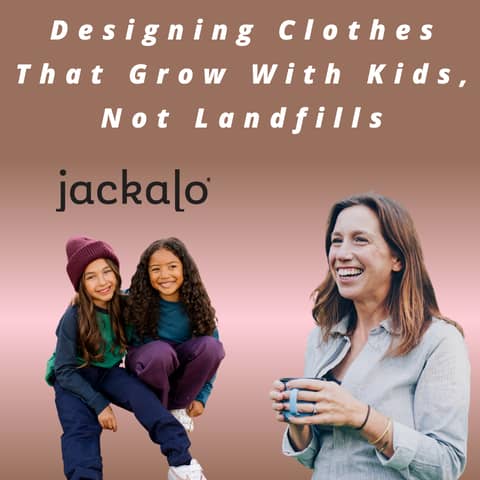

I’ve always believed that behind every meaningful brand is a deeply personal story, and my conversation with Marianna Sachse, founder of Jackalo, is a perfect example of that. What stood out immediately was how her journey is...


I’ve always believed that behind every meaningful brand is a deeply personal story, and my conversation with Marianna Sachse, founder of Jackalo, is a perfect example of that.
What stood out immediately was how her journey is rooted in gratitude, craft, and family—particularly the skills passed down from her mother and grandmother. That foundation shaped not only how Marianna sees clothing, but how she sees responsibility, longevity, and care across generations.
As we talked, it became clear that Jackalo isn’t just about kids’ clothing—it’s about rethinking the entire system. From durability and timeless design to circularity and ease for parents, Marianna has intentionally built a brand that removes compromise.
She shared how her background in nonprofit communications, combined with her experience as a mother and maker, pushed her to solve a problem she saw firsthand: kids’ clothes that don’t last, don’t get handed down, and too often end up in landfills.
In this episode, we discuss:
* How learning to sew, mend, and value craft across generations became the foundation of Jackalo
* Why kids’ clothing is uniquely positioned for circular design and reuse
* The trade-up model that allows parents to return outgrown clothes for store credit or recycling
* How natural fibers, durability, and thoughtful design reduce waste and support kids’ comfort
* Why making the sustainable choice easy is essential for busy families
Join me, Ramon Vela, in listening to the episode to hear how Marianna is building a product worth buying and a brand worth supporting—and how reimagining kids’ clothing can make life easier for families while keeping clothes out of landfills.
For more on Jackalo, visit: https://hellojackalo.com/
If you enjoyed this episode, please leave The Story of a Brand Show a rating and review.
Plus, don’t forget to follow us on Apple and Spotify.
Your support helps us bring you more content like this!
*
Today’s Sponsors:
Saral - The Influencer OS: https://www.getsaral.com/demo
SARAL is the all-in-one influencer platform that finds brand-aligned creators, automates outreach, and manages everything in one place. Request a live demo today. Let the SARAL team know you're a The Story of a Brand Show podcast listener to get an extended free trial! Visit the link above.
Ramon Vela (00:03.49)
Welcome back everyone. This is going to be a great show. I have with me Marianna Sachse Sachse. We do that again. Did I say that correctly? Sachse Marianna, right? Pause, unpause. One, two, three. I have with me today Marianna Sachse who was founder and CEO of Jackalo. Welcome to the show.
Marianna Sachse (00:48.691)
Sachse. Yep. Marianna Sachse. Yep.
Marianna Sachse (01:05.439)
Thanks for having me, Ramon.
Ramon Vela (01:07.02)
Yeah, and I apologize if I just messed up your name again. For some reason, when I look at your name and then how I pronounce it, it just throws me off a little bit. I actually, is it French? Your last name?
Marianna Sachse (01:13.301)
you
That's okay.
Marianna Sachse (01:19.921)
My last name is German.
Ramon Vela (01:22.03)
Oh, interesting. Yeah, I like it. Actually, it looks it there's some words when you look at a word and you think like, oh, that is that looks like a beautiful word. And when I love the S, the A, the C, how they all fit in there. But at the same time, though, it makes it very difficult unless, know, German, guess, makes it difficult to understand how to pronounce it. So. Yeah, I love it. And so let's see.
Marianna Sachse (01:33.332)
Yeah.
Marianna Sachse (01:44.913)
Most people don't know how to pronounce it.
Ramon Vela (01:51.882)
I love to dive into your story and unpack why it is that you do what you do. However, I always like to start off my interviews with the question of gratitude. And for anyone who's listened to the show, anyone out there, any new listeners, I ask it for a couple of reasons. The main reason I ask it is, well, I should say really there's two main reasons. they're both really important to me. One is I just think it's a great way to start off a topic of someone's
journey, what they're grateful for. It allows you, the founder, to think back and remember and just give a thought about those people, those times, those events, those moments where...
You're very grateful for someone's help or someone believed in you or something happened that you're very grateful for. And I just I'm a big believer in gratitude. And that's actually the second thing is that gratitude is one of those things to me is that if you are feeling stressed, if you're feeling anxious, then gratitude is a power is something available to you at any time. I actually went through some very difficult times with my business, but also with my personal life, with my family.
And gratitude is something that has helped me throughout those really dark moments of my life. I have a gratitude meditation practice and you don't have to do the meditation. You can do journaling. You can just simply just give thanks. Whatever it is, the gratitude is really, really powerful. And neurologically, you can't have anxiety and gratitude at the same time. And that's how powerful it is. So something everyone else should consider.
Marianna Sachse (03:31.445)
I love that.
Ramon Vela (03:35.82)
So let's get started. I have a strategy question I'd love to give to you and basically is share a moment or memory when someone did something for you that just made you feel grateful because it meant that they believed in you, your vision or your potential.
Marianna Sachse (03:51.285)
Yeah, for me, it's not one moment, but a series of moments. It's my mother teaching me the importance and value of craft, of learning to sew your own clothes, of learning to knit embroider, of keeping that, and it's a punny way to think of it, but it's true that thread of that skill.
alive through multiple generations. And so I still use the napkins that my grandmother sewed. In fact, actually, that's these are her threads. Don't try to use them. They're in terrible shape. It's just for memory. But the fact that my mother not not only believed in my ability to carry this through, but believed in the value.
of carrying this skill set through to the next generation is something that's really important to me and is kind of foundational for what I do, excuse me, for what I do now. And I'm a really big believer in this kind of DIY perspective to your life that if you see something that you love, that you think is beautiful, that you can...
at least learn and try to make it. And worst case scenario, you have so much more appreciation for the skill that somebody else puts into something when they create it. And best case scenario, you've gained a new skill that you can employ throughout your life.
Ramon Vela (05:33.868)
Yeah, well, I love that. I really, you know, and it's actually funny that you bring this up because for me, it just happened just it's been something that I've been thinking about the last month or so, but the value of having a crowd.
the value of working with your hands. I kind of almost feel like in some ways, so many of us, at least me, because I've been working from home and I've worked, I don't know what you call office jobs, I've worked as a, what do you call it, information worker, whatever you want to call it, but I almost felt divorced from my body and from my hands.
in terms of the work I do. And even just getting up and working and so forth. And us humans have been, we've been working and getting up and walking, whether it was hunters and gatherers, whether it a farm or a graverian society. And I kind of almost feel like, we had a craft that we would do.
And now we kind of don't. It's almost like a lost art in a way. I don't know. Maybe I'm being too dramatic, but yeah.
Marianna Sachse (06:42.429)
No, it is. I went to a school that didn't have woodworking and didn't have home economics, which is something that a previous generation would have had at every single school. And I luckily learned a lot of the sewing and craft piece from my mother and learned some woodworking at summer camps. But
if you wanted to learn those skills and it wasn't part of your educational curriculum, it was something that you had to go out and seek. And I think that there are lots of generations now since my childhood that have lost this art. And we see a kind of coming back to it. Post social media, we have had all of these opportunities to cultivate our life online.
And people have forgotten about the opportunities to cultivate your life in person and in community. And we're seeing a resurgence in that right now that more people want to learn how to knit. They want to learn how to sew. They want to do woodworking because
Marianna Sachse (07:56.521)
because we need that really tactile feeling that you were just talking about that forces you to be in your body and forces you to be connected. And just as a gratitude meditation is a very valuable process and valuable for your mental health.
Ramon Vela (08:21.774)
Let's be, I apologize, go ahead. Unpause.
Ramon Vela (08:29.038)
Sorry, let me pause it. Let me just turn this off.
Marianna Sachse (08:29.877)
It's okay.
Ramon Vela (08:46.446)
Okay, should be off. All right, unpause, one, two, three, go.
Marianna Sachse (08:51.561)
just as a gratitude meditation can be incredibly positive for your mental health, there are definitely reports from like medical journals that craft thinking like things like knitting can lower cortisol levels. And so it's that kind of repetitive motion that's very much kind of in your body that seems to do it. And I would imagine though I don't have any data on this that
if you were to engage in gardening, engage in woodworking, know, whatever it is that is that kind of crafty, repetitive motion would have the same impact.
Ramon Vela (09:30.958)
Yeah, and I mean, think just, you know, going back to your original gratitude story, that's such a wonderful gift that you were given in terms of your mother. And I think in some ways, well, not some ways, I think it almost is a good transition to talking about what you're doing now because...
What's interesting to me is that as you were discussing that about your family and how you learned this, I started thinking about when I was young and we had, there's nine of us in that family. I know that's a large family, but I'm sure people, families back in the seventies or before that were, even when they were small, had less people in their family were practicing this, but we had hand-me-downs.
Marianna Sachse (10:25.311)
Mm-hmm.
Ramon Vela (10:25.646)
And my mother, it was just a craft that she knew, which was to sew, to hem, to change, alter, you make altercations. And I just remember it just seemed just so natural. Like she just knew what to do. My grandmother knew what to do. It just was a craft that was taught and passed on to people and so forth. Nowadays, like my family, my wife doesn't know, I don't know.
Marianna Sachse (10:36.543)
Yeah.
Ramon Vela (10:52.27)
Kids don't know it. No one knows it anymore. yeah, the other day it was, I think this was like a few weeks ago, we were talking about a gift my wife got for, oh yeah, it was for Christmas. And she loved this top, but she didn't like the bottom half of it. And she was like, maybe I should just cut it off. And I'm like, well, maybe you cut it off and we'll have someone hem it or something like that. And we were started looking around and we're thinking like, wow, it's so expensive. Like we never looked into this because I think
Marianna Sachse (10:54.931)
You can learn it.
Ramon Vela (11:22.224)
no one knows how to do it. And it's become a specialized skill that is in demand because there are times when we need it. But it's just, I'm just remembering back when I was a kid in the seventies, was, you know, five, six, seven years old. I remember my mother, it was just a skill that people knew. And I feel like it's that hand me down, that using the clothes, you know, over different people.
Marianna Sachse (11:40.778)
Yes.
Ramon Vela (11:50.412)
you know, altering it, changing it, things like that. You know, that was such a valuable skill. And in some ways, I guess that's how we were using, this was before fast fashion, you we were reusing clothes. were like, you know, it was a kind of circular way. But yeah, and that kind of comes along to what we're talking about here. So why don't we use that as a good transition and talk a little bit about
how that fits into what you're doing now. Tell us a little bit about what you're doing, and kind of like a high level overview, and then we're gonna go back and then unpack a little bit of how you got there.
Marianna Sachse (12:27.977)
Mm-hmm.
Marianna Sachse (12:33.077)
Okay, great. So yeah, I started and run a company called Jackalo. We make long lasting, comfortable and sustainable clothes for kids. And then we buy them back when outgrown to be renewed and resold or responsibly recycled. And the thing that we do that's really different from other brands out there is that we designed for circularity from the beginning. So we think about...
all of the components of design, how that's going to contribute to the longevity of the item, whether that's through durability or through just the ability to withstand a few growth spurts. We also think very carefully about what the items are made from. Are those materials recyclable with today's technology and are they compostable at the end of their usable life?
And then at the end, when we're buying the clothes back, we resell them on our own platform so that it's really easy for parents to find both new and pre-loved items on our website and to have a single checkout experience. So you don't have to go somewhere else to find our items secondhand. You don't have to have a separate checkout for secondhand items. They're all very clearly labeled as pre-loved.
but it's still like you can get a pair of pre-loved pants and a new shirt in one checkout and it's really easy for your kind of shopping practices.
Ramon Vela (14:05.164)
Yeah, well, and there's a lot to unpack there. But kind of going back to the example of the 70s, you know, it feels like you're incorporating some of those components of what we just talked about, where you can, you've taken it a step further. You've actually designed the clothes in such a way that allows you then to be durable, which is something I've had this conversation with other founders before.
which is one of the ways to be sustainable is to essentially create good clothes, good, durable clothes that last. And so they're meant to be reused, to resold, to be rethrifted or however you do it, resale. And that is a way to kind of battle against this sustainability issue and the fast fashion and the landfills, et cetera.
Marianna Sachse (14:41.299)
Yes.
Ramon Vela (15:03.168)
And so I really love that aspect of it. I love how you pre-plan it and so forth. And I want to break it down further.
Marianna Sachse (15:05.717)
Thank you.
Ramon Vela (15:09.582)
But let's get started. Let's talk a little bit. Let's take a step back. What I'm very, very fascinated by is, and I think the audience is too, you know, it's a reason why Shark Tank is so popular and so forth. It's looking to be popular. There is, well, I have a belief that everyone has an idea in their life. Everyone has something that says, hey, you know, if they made this product a little differently, it would be a better product. Or how come they haven't created a product for this
this or that and so forth. People have ideas. But hardly anyone pursues those ideas. But there is a small percentage of people who have an idea and then run with it and take off with it and take action.
And a lot of times they may not even know anything about the industry they're in or whatever. And I mean, if I had a nickel for everyone who told me like, well, I make clothes, but I don't know anything about textiles or I mean, you know, this or that, I don't know anything about health and wellness. You know, I mean, they start off not knowing, but it doesn't stop them. Like it takes it. It pushes them to learn about the industry, to learn about beverages or food or whatever it is.
I just love that. love how people, I love to understand what is in your brain that makes you take that leap. Because the other side of it is there's naivete to it because this is a difficult endeavor. It's...
Marianna Sachse (16:45.629)
It's very difficult, yeah.
Ramon Vela (16:46.958)
challenging and a lot of people tell me like hey if I knew how challenging it was maybe I wouldn't have tried it but there's you know there's a naiveté there's a passion there's a love for doing it and it just kind of forces you to do it so I am curious where were you before and what pushed you you know what would push you off the fence to actually start this
Marianna Sachse (17:09.973)
Yeah, so before I started this, was working in communications for nonprofits and foundations. So I worked with large foundations focused on health and wellness in the United States, on economic issues and the environment, supporting them with their communication strategy. And I think the biggest inspiration in that piece was that
I had the opportunity to support through a foundation's work, the work of St. Vincent de Paul and Eugene Oregon. they were rescuing mattresses from the landfill and tearing them apart so that they could be recycled and making dog beds out of them. And I just really loved this concept.
of doing something that is really eco-friendly, that is making a new product and making good quality jobs for people who need it. And it was just kind of inspirational to me to see like, this was a really interesting way of flipping a problem on its head and coming up with a solution.
when I learned about that organization, I hardly remembered this, a friend of mine reminded me about it when I started Jackalo. I said to this friend, I was like, you know, I really want to have a business that, you know, is making some that's doing something like this, like making something good and creating good jobs. And I guess I had that somewhere tucked away in my head for a really long time until I figured out what it was.
what the it was that was going to be made. And that came about because of my own kids, really because of my older son. And we were lucky, like you and your family to receive tons of hand-me-downs. But this was at the time when fast fashion was really picking up. And so what I started to see when he hit about age four was that we weren't getting any pants. Like they just...
Marianna Sachse (19:35.945)
didn't come to us anymore. we weren't, when I would go to the thrift store, I just really didn't see very much in terms of pants for our son. And then I would buy him new clothes and they would fall apart. And I would mend them. And most of the people I know didn't know how to mend and people would really pay attention to the mending job I did and be like, that's really cute. Like that actually looks good. And I could just sort of see that there's something there.
that I wasn't the only person having this problem, that I was having a lot of trouble finding good quality things secondhand or good quality things new, and that there needed to be somebody who was doing this. And I started doing research on two, like high quality kids brands who's doing this and who's creating clothes that actually last to the second and third kid. And
None of the responses were satisfactory. They were using materials that I don't particularly like. They're using a lot of polyester. Maybe they had dubious practices from an ethics standpoint. And I kind of thought about it and just felt like nobody's going to fix this if I don't. Nobody's going to try to come up with a solution if I don't. And that's
probably is not true. mean, there might be someone who would do it, but I just felt like my combined experience of being a mother and being a maker and someone whose job it was to care about people and the environment gave me a skillset that was very different from what any fashion company would bring to the table.
and a skill set that actually has a lot of value. And I felt like I could offer something and kind of worst case scenario, I teach people about a different way it can be done.
Ramon Vela (21:43.022)
Well, I mean, I think what you've done really is just you've been very thoughtful of your of the process and all the things you've added to the to the company. When I first saw your company, your story come across my desk, I was really intrigued by it because to me, this is a trend that and I still don't know whether we're there yet or whether we're on the way there yet, but I think we're
farther along than we were like just a couple of years ago when I was talking to some other companies who had ideas similar to yours. And I think we're very close because like just take for instance, and by the way everyone, if you wanna go take a look at what we're talking about, you can go to hellojacklow.com and that's the word hello. And then the word Jacklow is J-A-C-K-L-O.com.
I'm sorry.
Marianna Sachse (22:41.991)
it's, sorry, it's J-A-C-K-A-L-O, Jackalo.
Ramon Vela (22:45.774)
Jack, I spelled it wrong in here. I actually spelled it right, but then I spelled it wrong when I spelled the domain. So it's hello Jackalo. I should have realized that. That's J-A-C-K-A-L-O.com. And so you can take a look at what we're talking about. But you've included elements in there like the circular.
concept and we'll go over some of these just to make sure that the audience knows about it. But also just the durability, the design, the material, the fabric, the resale. And I've noticed that each one of these components is becoming more popular or at least trending in some areas more than they were before. Resale, for instance, I think it's having its moment right now.
And it's not just, know, like people would say it's about the economy and so forth. And I guess that is probably a driver, but it's also, I think what I've noticed is a lot of the people driving this are like Gen Z people or younger or in that, know, or maybe, you know, maybe a little older.
But they're driving this and they're driving and I don't know what the motivation is, but I know that they're driving this. My daughter, instance, 19, she's actually left right before I started. We started this interview and she's going to the Goodwill bins. I know if you've ever heard of that. It's the, you know, the Goodwill has these bins where you like, it's like, I went with her once and it's a mad house. you have to aggressive. People are just looking and pulling stuff out anyhow, but she's going there and she goes there, you know, she goes to these type of.
Marianna Sachse (24:13.437)
Mm-hmm, yeah.
Ramon Vela (24:28.208)
things all the time. And for her, it's really about finding old clothes and cool clothes. But there's always something that usually is predominant in the sense that she's looking for clothes that are good, that have lasted and still continue to look good, that were designed well. And that reminds me of what you're doing here. And you've just simply institutionalized it into one brand.
that has all these really cool concepts, including the resale, and we'll go over that in a second. But to me, it feels like you've just added a very easy system for a parent to feel good about. And I really feel like the more that people understand this, because parents understand this just, I think, just intuitively as they start raising kids.
and they think, well, you know, my son, he'll be able to use that, you know, that shirt, you know, later or that jeans or whatever it is, pants. And they know it intuitively and they pass things along, I think just like organically, they just go ahead and do it. But what I love is that you've created, you've institutionalized, you put it into a brand that does, has all of these elements all in one.
and allows the parents to feel good about the purchase, knowing that they could be resold and then it could be reselled to you. It could be handed down. There's all sorts of different options for them to do. So why don't we get started on that a little bit. So, I don't know if you wanna go through the process or if you want to talk about certain concepts because...
I don't know how many people understand about circular, the circular economy or circular, the circular concept. So I don't know what you think best. Do you want to tackle some of these larger concepts and then go back and we'll go through the process or go through the process?
Marianna Sachse (26:26.911)
Let's start with the circular, but before I come into what that is, I wanna make a comment on the parents, what you were saying about parents intuitively understanding this and it being something parents can feel good about. That piece of something parents can feel good about is really critical to what we do. As a parent, I know that we compromise on so many different aspects of our lives.
that there's just too much to possibly do to be able to kind of live a no-compromise life, to do everything that you wanna do, to do it the way you want to do it. And I think children's clothing is often in an area where parents are compromising, that they are compromising on the materials that they'd like to use, they're compromising on their values, they're compromising for efficiency and ease.
And my goal with Jockalo, aside from keeping kids' clothes out of the landfill, which is a huge problem, and we'll kind of get into that in the circular piece, the other piece of my goal is to just make parents' lives a little bit easier, to make it so that they can make the sustainable choice the easy choice, and that that choice represents value for them, that it's not just doing something good for the planet or something that feels
far away, it's doing something good for like their family. And that feels really close to home, whether it's that their kids are, you know, wearing something that's like less likely to trigger eczema or ash allergies, or that, you know, it's one less fight in the morning about what the kid wears to school, all of those things contribute to, you know, family discord. And
I just want families to be a little bit happier and this is one way that I can do that. And so the fact that you picked up on that piece of ease for families is really important to me. It's something that I really value. But when it comes to circularity, circularity is something we in this industry and in this space talk about all the time.
Marianna Sachse (28:47.263)
But I think a lot of people really don't understand what it means. And it's a fairly old concept, but just not a super popular one. Or it's becoming a little bit more popular right now, feels a little buzzy. But typical economies are linear. You make something, you use something, you dispose of it. That's a linear economy. And circular economy is really just something that is designed to be made.
used, reused, refashioned, know, bring it back around to be made into something else or to be used kind of indefinitely or until there's no way to use it anymore. And so with kind of where we're going with Jackalo is to say, how can we think about circularity and reuse in every piece along the way that we want to make sure
that we're designing for that, that we're making our systems for the families easy for that. So I understand that, you know, in a large family like yours, your family is gonna keep the clothes and hand them down to the kids, the next kid in the family. That's a natural circular system. You don't need any tech for that. You don't need any outside support for that. It's just something that people do.
And it's the same thing when you say, all right, my kids have outgrown these. I'm going to ping my friend who has a kid who's a year younger, two years younger, and see if they want anything. If any place can make the circular economy work, it's children's wear. Like it just makes so much sense because of how quickly they grow. And so it's ridiculous that with fast fashion, the system breaks.
because the clothes are such poor quality. They should be able to make it through for kids easily. This is what we should expect of clothes. For the average user, there are definitely kids out there who are not the average user who are gonna bust through everything and that's okay. I don't want them to be told, don't play the way you need to play. But for the average kid,
Ramon Vela (30:55.661)
Mm-hmm.
Marianna Sachse (31:14.249)
that item should be able to make it to their sibling and to their neighbor and all of that. And that's what we're trying to facilitate as much as possible by making better products and then making it easy for when you don't have that network in your community. If you don't have multiple kids or if you don't have a kid in your neighborhood that's the perfect kid to receive it, then we're the place to send it back and we will take care of it and make that piece easy for you so that you don't have to.
Hold on to something in your house, maybe do the photography and hope you can list it on Poshmark and eventually see if somebody is gonna buy it there. That's just more work that parents don't need. And I don't want them to have to do that if it's unnecessary.
Ramon Vela (31:59.212)
Yeah, and so I love what you just said and that's a good reminder too, because I remember as a parent, either talking to, either giving or getting like hand me downs from their kids, right? So yeah, kids were already older and our kids were coming into age and they're like, hey, we're gonna give these clothes away, but you know, would you like to look and see if you want any?
Marianna Sachse (32:14.803)
Yeah. Yeah.
Ramon Vela (32:24.75)
I mean, we were doing that all the time. And then we passed on our clothes to other families too. It's just something you do when you're around families. And the cool thing about what you just said too, that kids' fashion or kids' clothing is the perfect opportunity to do these things.
It's because we're kind of already doing it in some ways, know, like in terms of handing stuff down. And the other good news is that, is that we, when you have kids, I'm sure this is, this is, there's anomalies to this, but I think by and large, when you have kids, you tend to be around.
couples and other families that have kids. Like it's just part of the part of the thing, right? Like they have classmates or they in a club and you know, they're participating, you're participating, they're doing softball or baseball, whatever it is, they're always going to be around other families. And so the cool thing is that when you when you have a when you have something that you found something that's really cool or you're doing something
Marianna Sachse (33:10.57)
Yes.
Ramon Vela (33:33.87)
It gets passed along, people learn about it, you tell the parents about it and so forth. But the point is that to me, like, I think you're right. The kids' fashion is probably the best place to do this, or at least to start off with, because it is just, such an easy concept and thing that parents are kind of already doing in some ways.
and just allows it to really just have a structure around it. yeah, I think you're right. I think the kids area is just such a good. I hadn't thought about that until you just mentioned that, that's another reason, another great reason for this. I don't know if I'm getting ahead of myself, but in terms of materials, I know that families and parents care more about materials nowadays, especially with the non-clothing stuff that we're doing, because now we're hearing about all this.
plastic or lead in our food or all sorts of stuff that's going on and in things getting into our bodies and then of course the way the fabrics are made people have allergies and so forth. Walk us a little bit about that in terms of how you design and the fabrics that you use.
Marianna Sachse (34:42.293)
Yeah. I mean, I think the first thing to remember is that polyester is plastic. There's no difference and it is made from plastic particles that are heated and spun into a thread. And so it is a fiber that is very durable, is why durable and cheap, which is why a lot of brands use it. But it has risks to it. mean, number one, you know, it
It is a non-renewable resource. But number two, we see it in our food systems. It sheds microplastics. Those microplastics end up in the fish food chain. And we also see it entering in human bodies in all sorts of ways. We don't know the full risk of that, but what we do know, and this is very basic, is that any pediatrician
who sees a kid with eczema or sees a kid without like allergies that are like showing on the skin. The first thing that they will say is wear more natural fibers, less polyester, more natural fibers, avoid the chemical, the harsh chemicals that are used to dye clothes, the AZOs, and try to move in that direction.
So we're really focused on using those natural fibers and a side benefit of really sticking with natural fibers is that they're compostable at the end of their usable life.
You can, with natural fibers, have fibers that are very strong. There are some that are not going to be very strong. So if you think like, you know, like a silk, that's a delicate fabric. Hemp, very, very strong. Linen and cotton are somewhere in the middle. And so you have to balance strength and comfort. And for us, you have to also balance the sustainability and what
Marianna Sachse (36:55.881)
what the end of use is gonna look like. And so I could have picked a fiber, a fabric that was the most durable fabric in the world. And I could create a pair of pants that would never rip. Not necessarily gonna be comfortable. Definitely not gonna have an end use case. Like we know how to recycle it or how to dispose of it.
And so I had to be very conscientious about how do we balance all of these things? How do we design for comfort, durability and sustainability with our fabric choice? And so I focused on organic cotton because it's readily available. It can be slightly stronger than conventional cotton. Depending on the weave, can get a...
strength there. you can see everything from with cotton, you can see everything from like the most diaphanous tissue tee to the like hard as a rock jeans. And so our goal is to get somewhere in between that. And then add in features like, you know, reinforce knees to make sure that it's really strong where it needs to be most strong. But for us, it really is this combination. How do we weigh like all of the things we want to be?
and get as close as possible to that.
Ramon Vela (38:24.888)
So, and thank you for that. And, you know, I just also want to bring this around to something. I don't want to wait till the end to talk about this, but everything you said, like, love how you've designed. I love the fact that, I love the thoughtfulness of the design and of the fabrics.
And what I mean also by design is like how you design in terms of them to be durable so they can have multiple lives. And I think that's hugely important, especially in the kids arena. But I also want to say too that something you said earlier, and I don't know if you used this word, no, actually you did. I also just want to make sure that we say this again.
no compromise because I think what has happened with a lot of in the past with not just not your kind of company per se but just sustainable companies things like this is there that people I think have gotten the wrong impression
that in order to be sustainable, to care about the environment, they had to make compromises, compromises on design and look and feel and usability and so forth. And I don't think that's case anymore. so there is no, I want to make sure that the listener knows if you're listening out there and you're a parent or you're a parent to be, or you're no parents, there is no compromise at all.
to the closing. So again, you can go to and I'm going to spell it correctly. Hello Jackalo, which is J A C K A L O dot com. My daughter's name is Jacqueline. We call her Jack. And so I'm going to start calling her Jackalo. I like that.
Marianna Sachse (40:21.215)
I love it.
Ramon Vela (40:22.282)
And so hellojackalow.com is the website. Now, if you go to that website and immediately there's images of the clothing and the kids, and then of course you can take a look. But the clothing to me is, I mean, the design is great and it's comparable to anything, place you go. There is no compromise on the design. And when I say design, the look, the way it looks, the types, the feel, you know,
the shirts, the dresses, the pants, et cetera. There is no compromise to what your kids will wear. They look great. They look like they're having a lot of fun. sure I their models and so forth, but they look like just like stuff that kids would love to wear. there's just like, there's no compromise in terms of like, they're not gonna be wearing anything weird or anything like that. I don't know. Sometimes people say like, natural fibers and this and that. No, there's no compromise with
or wherever. mean, all you have to go to is to hellojackalow.com and you take a look for yourself. And to me, know, bottom line, Marianna, is that's what people want. I think, you know, it's like the same way I talk about in terms of products for health and wellness or, you know, or supplements or food.
It's like people, they, you know, you can make really great products. You can make them good for you and so forth. But the bottom line is taste, right? Like people want something that tastes good. And I'm one of those weird people that I will, if something's really good for you, I will like just eat it without, without necessarily it being taste good. But of course we want it to taste good. We want it to enjoy our food and so forth. And I think what you're doing here is the equivalent to that. You've, you are the equivalent of a better for you
product, but also it tastes good. It looks good. Right. And, and I think bottom line, that's what parents want. I mean, they want their kids to like what they're wearing. They want their kids to feel comfortable with what they're wearing and so forth. And I just think they're, I think they're designed really well. I mean, I wish I would have had some of this stuff. Or if you have this in the adult size, I'd buy some of this stuff. It looks good. mean, I like it. I did notice you had, a mom.
Marianna Sachse (42:33.375)
Thank you.
Marianna Sachse (42:38.877)
Not yet. Not yet.
Ramon Vela (42:47.222)
Is it overalls or?
Marianna Sachse (42:48.853)
We have a coverall. Yeah, we have a coverall. Yeah, from a design perspective, a lot of what I do is really inspired by vintage workwear. that style kind of screams that it's quality, it's gonna last. And I've seen work where I have this wonderful chore jacket that I bought when I was living in the Netherlands that's probably 50 years old.
Ramon Vela (42:51.598)
Well.
Marianna Sachse (43:18.801)
and it's still fully functional. And I want parents to see that in it, also see the kind of more youthful version of it. So while there's elements that are like pulled from workwear from the United States, from Europe, from Japan, the colors are not workwear colors. Like the fabric choice is not.
workwear fabric, it's all designed to be really comfortable for kids, but avoid the trends. And that's the thing that I, you know, I think always gets in the way when you do have a hand-me-down that's decent quality, that's made it to that next kid. The thing that can make it feel not usable is if it feels like a trend that has passed. You know, I remember getting
for my son, I hand me down from my aunt and uncle that they had used for their son. That was these like acid washed jeans for a baby that had like the craziest shape. They probably would be in now, but they were very much not in when my son was born. And they also did not seem particularly comfortable. And I kind of looked at it. It's like, what a waste. They they held onto it.
But if I dressed my child in it right now, everyone would be like, what is he wearing? And I want families to feel like, I can hold on to this for a year or two or even more until my next kid is old enough to wear this and it will still look contemporary. It's really a focus on timeless design.
so that you're not worried about it being so passe by the time it gets to your next kid.
Ramon Vela (45:21.942)
Yeah, and I think that's important. I personally just, like that, that timeless fashion or design or however you want that look. And I want to just make sure that people know that at hellojacklow.com, and I'm gonna ask you for a little bit more info on that.
on this in a second, but I just want to quickly let people know. Like you go to hellojacklow.com, they've got, and I can appreciate what you've done here. So you've broken it down. The navigation buttons are really easy. You can look at kids, you can look at tops, joggers, pants, jeans, and shorts, dresses and shirts. You have featured shops, which I actually really liked the way you broke this down. You have back to school.
You've got uniform friendly, which my kids actually went to private school. So that would have been really cool. Outfit ideas, sensory friendly, best sellers, women's shops. And then of course you have the preload navigation button, the sale button, and then a trade up. Is there, so.
By the way, before I ask you the next question, I wanna let you know, I really, on this show, I have a tagline and I really love to find companies that meet this tagline. Like I love to be able to say that, wow, this is exactly what I would, like as a shopper, as a parent.
Marianna Sachse (46:42.069)
Mm-hmm.
Ramon Vela (46:42.99)
is something I would really love. And that's a product, I refer to it as a product worth buying, a brand worth supporting. Because I want to feel good about the company that I'm doing business with, but as we mentioned earlier, the product has to be good, right? Like it has to be, like if it's a food, it has to taste good. If it's a supplement, it to do what it says. You know, if it's clothing, has to look good as well and be designed well. And I kind of feel like you meet that criteria, which is a product worth buying and a brand worth supporting.
So I love everything that you're doing with the brand and the circular concept and all of that. But you also are making really good clothes. And this is something like if I had young kids and, you know, hopefully when I say they'll have grandkids, this is the kind of stuff that I would want them to wear as well. So so.
Marianna Sachse (47:13.823)
Thank you.
Marianna Sachse (47:30.645)
Thank you.
Ramon Vela (47:31.31)
I just want to let you know that to me this is a great brand. People should be looking at this. with that said, would you like them in the journey of your brand, where do you want people to start? Where do you want them to go? What do you want them to try first?
Marianna Sachse (47:52.103)
in terms of a product or okay. mean, yeah. I mean, come to our website, get to know us, like read about the brand, join our email list. We're not like spammy or anything like that. I try to always contribute information that is helpful in the emails. So, you know, we,
Ramon Vela (47:54.21)
Yeah, I was listening to this and you know, do you want to start?
Marianna Sachse (48:19.763)
do have blog posts and things like that that are really focused on how to buy better clothes for your kids, how to live a more conscious, thoughtful life. But in terms of our products, I really invite you to start with our, if you've got a kid who's more sensitive, our Chi sweatpants are really, really well loved.
And then our ash pants are a perpetual favorite, particularly for kids who are a little harder on their clothes. So these are the kids who are climbing trees, the kids who are sliding on their knees. We do offer free repairs for the first six months. And when you trade up with us, you've got a substantial store credit back that's more than you would get on like,
If you were to send it to an outside consigner, it's more than you would get for that. And it's less time than it would take you if you were selling it on Poshmark or something like that. So it is a good value to trade up with us. So I would really encourage folks to look at those two pair of pants, see what else works for them and engage in our trade up program because it's, you know, it makes a lot of sense. It's really economical and kind of a side benefit of that is that when we, you know,
post items that we get back for resale, we're posting them at a significant discount, which really makes this type of long lasting sustainable clothes available to more families. So I think one of the challenges that sustainable fashion faces is that it is more costly to produce these items. And so the items themselves are more costly and it makes it, it can make it harder for families that are on a tighter budget.
to opt into this. And so this allows us to help more families opt in to clothes that are better for their kids and better for their families.
Ramon Vela (50:24.846)
Yeah, and I love that. again, it's hellojoclo.com is the website. And to me, the actual look and the design of the clothing is great. I think some of the shirts, the dresses, I think are really cute. And so just so we leave the elements with the understanding of how this works.
Marianna Sachse (50:43.839)
Thank
Ramon Vela (50:50.046)
And so correct me if I'm wrong. So if I'm a parent, I'm going on hellojacklo.com. I'm taking a look at the clothing there. I might take your suggestion of the items that you just mentioned, or I can see a shirt or a top or another pants that I like. So I buy that and you know, like it starts to wear it and we use it and so forth.
In the off chance that they're very rough, that's the way I was, like my mom, my mom used to have to put a lot of those like patches on my knees and stuff. So let's say they started making some wear and tear and some, and you know, they need to be repaired. So for the first six months, I can send it back to you and you would repair it. Is that correct?
Marianna Sachse (51:21.237)
Mm-hmm.
Marianna Sachse (51:33.653)
Mm-hmm. Yeah, that's correct. after that, we accept those items back for our trade up program, regardless of condition. And so what we will do is if it's in a condition where we can repair it and resell it, then you get full credit for the item. If it's in condition where we have to just recycle it, then we give you a $5 recycling credit, know, $5 in store credit.
to our website really just as our way of saying thank you for recycling responsibly, for not throwing this in the landfill because we know that 85 % of all textiles in the US end up in the landfill. And if we can work together to put a dent in that and keep some of those clothes out of the landfill, I really would like to do that. We'll then use those items that are like beyond resellable condition to, you
make patches and support repair of our existing items and then anything else would then get responsibly recycled.
Ramon Vela (52:38.89)
That's fantastic. so, okay, so then So you take those in and you repair them send them back and then but if I if my child uses the clothes continue to use them and maybe we pass them on to their brother or sister and they start to use it And or maybe they maybe we don't have any other kid to do that. We can always trade it up, right? We can send them back We can send it back and we get store credit and then we can use that credit to then buy
Marianna Sachse (53:02.695)
at any time.
Ramon Vela (53:08.624)
other items on the website, correct?
Marianna Sachse (53:13.033)
Yeah, absolutely. And the great thing is that because we use a single checkout, don't have like a lot of brands that are starting to operate a resale program. They operate their resale program on a separate website, which means two separate checkouts. So the credits you get for recycling with them or trading in with them, you know, really can only be used on new items.
And so for us, you actually can use those store credits on new or pre-loved items. Like I don't care which you're buying. I just wanna see the clothes get good use. Like you can buy pre-loved items, that's great. And so if you trade in with us, you're gonna get that store credit that you can use on anything in our website.
Ramon Vela (54:02.698)
that's fantastic. I know that's like a small little thing, but it could be annoying when you're parent and you're trying to do that. Because I know what you're saying is like they operate their resale as almost like a separate website.
And so I love the fact that you've combined that and just made it really easy for parents so I just have to say that just going over this and Talking this over with you just now in terms of like what the process is. It's like Why wouldn't anyone do anything? Why would anyone do anything differently? Like why wouldn't people not want to buy?
That's what I'm saying. You know, it's like, is such a great process. It's such a great deal. You're being sustainable, but even if you didn't care anything about this, the clothing is great. And the process, the ability to then have you fix it within the first six months and or trade up. I mean, why wouldn't you want to do this? Who cares about the sustainability? The process is just cool, but the plus is
Marianna Sachse (54:41.481)
Mm-hmm.
Ramon Vela (55:07.598)
you're also doing a good job for the Urofila landfills.
And I think from my tagline standpoint, I sincerely believe that, you know, if given a choice, people want to work with a good company, they want to work with people that have values similar to them. They want to work with a company that does good in the world, who cares about them, their community and their family and so forth. And so for me, it's like, you know, if you can combine both of those, which I feel like you do, then that's fantastic. You're a product with mine, you're a brand with support.
So I highly recommend everyone out there go to hello Jackalo.com take a look if you are a parent or you're a parent to be or You know a parent. I think it's a great website to share with them and and by the way, I think I saw this somewhere yeah, there's also gift cards so if you have if you're an uncle or an and you're and you listen to the show and you want to give a gift card to a brother or sister or a family member who has kids that's a great gift to give
Marianna Sachse (56:04.937)
Yes.
Ramon Vela (56:15.886)
some money so they can give this a try. So I want to be respectful of your time, Oriana. This has been fantastic. Anything you want to leave with the audience?
Marianna Sachse (56:25.853)
Yeah, sure. So one last thing is that if you don't have kids in your life, but you really like the idea of what I'm doing and want to support the business through the end of January, we are running a WeFunder campaign. You can invest directly in our business and own a piece of Jockalo and that you can find at WeFunder.com slash Jockalo.
That's running just through the end of the month. So you would need to make your pledge and verify your identity by January 31st. But that's a great way to support a business you believe in when you don't have kids to shop for.
Ramon Vela (57:10.742)
Yeah, that's fantastic. I love that. And we'll make sure to have that link on our podcast subscription so people can click on that. And then we'll do a post on that too for people who follow me on LinkedIn and other socials. Because I think this is great to give people an opportunity to be a part of this. And just also give us your website and socials, and your socials as well.
Marianna Sachse (57:18.933)
Thanks.
Marianna Sachse (57:34.474)
Yeah, it's
Our website is hellojackalow.com, J-A-C-K-A-L-O, and our social media, everything is at hellojackalow, and that's on Instagram, TikTok, Facebook, you name it.
Ramon Vela (57:51.616)
Okay, great. And then you have some spring products coming up pretty soon.
Marianna Sachse (57:57.661)
Yep, we're going to be, you know, knock wood receiving our spring inventory by the end of February. So we'll have those available in early March. We are also working on our first ever mini collection made of 100 % post-consumer denim. And so stay tuned on that. We don't have a delivery date on that yet. And but if you're on our email list, you'll be the first to know about it.
Ramon Vela (58:28.162)
Well, that's fantastic. Thank you for that. And thank you for sharing everything about your brand and your company. And there's so many other things we could have talked about. And I want to give you an open invitation to come back anytime you want. If you have an update, if you have new lines, if you're doing new things, whatever, 12 months, 24 months, whatever it is, you're welcome back to give us an update. And I appreciate it. And I wish you all the success because I love this brand and like everyone
Marianna Sachse (58:41.919)
Thank you, Roman.
Ramon Vela (58:58.096)
out there I just mentioned earlier. This is a product worth buying and a brand we're supporting and I highly recommend going and take a look. So I'm gonna have the links to the website, the socials, as well as the WeFundr. So go ahead and take a look at all of those in our podcast description, which you could find on Apple, Spotify, and anywhere else you look, you listen to your podcast.
Beyond that, it has been fantastic. We've just had Marianna Saxey, who is founder and CEO of Jackalo. And you can go to the website again, it's hellojackalow.com and take a look because like I said, it's a product we're buying and a brand we're supporting. And thank you so much Marianna for being on the show.
Marianna Sachse (59:39.807)
Thanks, Ramon.
Ramon Vela (59:41.614)
Again, everyone, go to the website, check it out. And as I always say, stay safe, stay sane, stay healthy. One way of actually being healthy, not only just for yourself, but for the Earth, is just taking it and be sustainable and having great clothes, is going to hellojaccalo.com and take a look at the clothing. Beyond that, everyone, let's just do ourselves a favor. People are stressed out.
People are anxious and there's all sorts of craziness in the world. Let's just do ourselves a favor. Just remember that everyone is going through something. And if we can just be a little kinder to each other, I know we can make this human experience a better one. Beyond that, thank you from the bottom of my heart for listening to another episode of the story of a brand.
